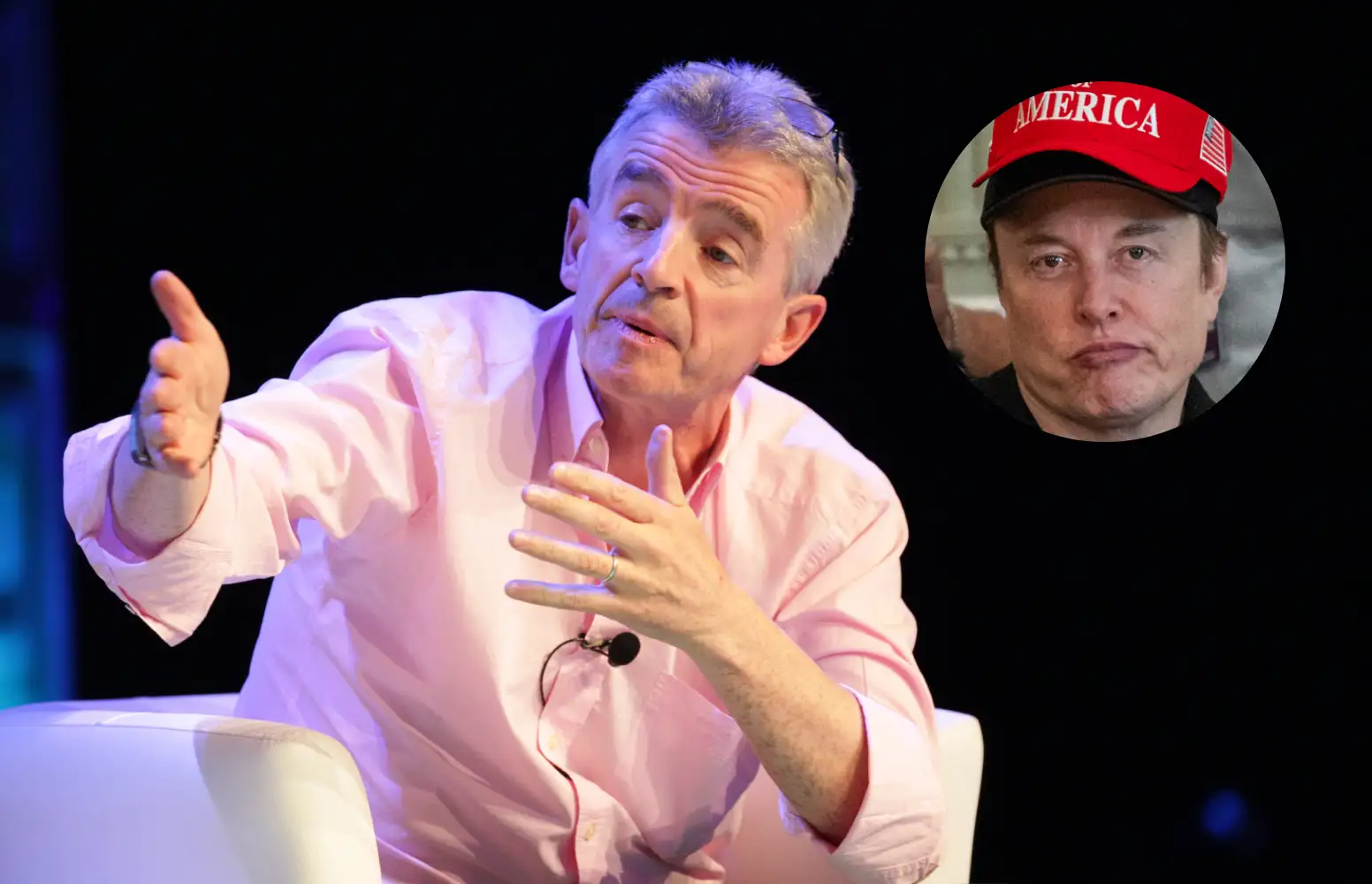
Ryanair’s chief executive Michael O’Leary turned a technical decision about onboard internet into a public dispute with Elon Musk, culminating in both calling each other ‘idiots’.
The argument came about following Ryanair’s rejection of Starlink satellite internet for its Boeing 737-series short-haul fleet. O’Leary put figures on his concerns, saying installing the necessary antenna and systems could cost $200 million-$250 million annually for the airline and raise fuel costs through increased drag, producing roughly an extra dollar in cost for every passenger flown. He added that Ryanair passengers were unlikely to pay for internet use and that free Wi-Fi would not justify the expense.
Talking about it on a broadcast on Ireland’s Newstalk radio, O’Leary said he would “pay no attention whatsoever to Elon Musk” and labelled him “an idiot. Very wealthy, but he’s still an idiot.” He went on to question Musk’s understanding of how aircraft operate, saying “What Elon Musk knows about flights and drag would be zero.”
Musk took to X (formerly Twitter) with his own response. He called O’Leary “an utter idiot” and suggested Ryanair should “Fire him” so that he could buy the airline and install someone called “Ryan” to run it.
The exchange escalated beyond boardrooms, with Ryanair’s official social channels joining the thread, mocking outages on Musk’s platform, and saying that Wi-Fi on planes is the ‘propaganda they’re not falling for’, prompting further barbs from Musk.
This discussion has since drawn scrutiny not just for the rhetoric, but for what it reveals about airline economics, connectivity investment decisions, and broader trends in in-flight services.
Ryanair, a famously budget-conscious airline
Ryanair’s strategy is unapologetically value engineered. The airline has built its success on offering very low base fares, controlling costs rigidly, and monetising almost every extra service. Flights often operate on short, point-to-point sectors across Europe, typically under two hours. This pattern defines how Ryanair views aircraft features and revenue opportunities.
O’Leary’s rejection of Starlink aligns with a business model that measures cost and revenue at the level of individual flights and passengers.
He has argued the costs of installation and ongoing fuel burn outweigh any potential economic return. “Passengers won’t pay for internet usage,” he said, asserting that a free offering would be used widely but not generate revenue, and a pay-to-use model would not attract enough uptake.
That approach extends across Ryanair’s operations. The airline’s ancillary revenue comes from seat allocation fees, priority boarding, checked baggage fees, onboard sales, and payment processing charges. Costs are lowered through rapid aircraft turnaround, dense seating configurations, limited onboard services, and a singular focus on utilisation and punctuality.
Those priorities have sometimes attracted criticism with strict baggage policies, insisting on digital boarding passes and the unbundling of amenities all generating controversy, while Ryanair also aggressively pushes back against what they perceive to be unjustifiable costs, such as taxes and airport fees.
O’Leary often defends the approach by pointing at competitive fares and high passenger volume, with his confrontational and direct style of communication making Ryanair’s intentions to be a ruthlessly competitive airline crystal clear.
.webp)
The airline’s corporate tone reflects that stance with O’Leary’s style trickling down into Ryanair’s social channels, where the airline leans into this reputation, often making memes at their own expense - and in this case, Musk’s.
This marks a departure from the typical muted corporate social media presence seen at many carriers, especially while many are embracing Starlink as a paid-for or even free service for passengers.
Starlink’s growing popularity within aviation
Starlink is the satellite internet service operated by SpaceX, using a constellation of low Earth orbit satellites to deliver broadband connectivity. In airline applications, it promises higher speeds, lower latency, and more consistent performance than many traditional geostationary satellite options.
The antennas used by Starlink are also significantly smaller, lighter and more aerodynamic than traditional Wi-Fi systems, swapping bulky radomes for flatter, phased-array technology.
These factors have encouraged its adoption across a range of carriers, particularly where strong connectivity is viewed as part of passenger experience or competitive positioning, while marginal savings on fuel consumption add up.
Across 2024 and 2025, Starlink has signed agreements with numerous airlines. Major global carriers planning or already deploying Starlink include:
- United Airlines – rolling Starlink across its fleet, offering free access for loyalty members and wider passengers on many jets.
- Emirates – scheduled to equip its wide-body fleet with free Starlink Wi-Fi, with rollout into 2027.
- Qatar Airways – operating Starlink on many Boeing 777s and expanding to Airbus A350s.
- British Airways and other IAG carriers (Aer Lingus, Iberia, LEVEL, Vueling) – set to introduce Starlink from 2026.
- Virgin Atlantic – planned installations on long-haul 787, A350, A330neo aircraft from 2026.
- airBaltic – first European airline to equip Airbus A220-300 aircraft with Starlink and offer free connectivity.
- Air France – partner with Starlink to introduce fleet-wide service by end of 2026.
- SAS Scandinavian Airlines – phased rollout of Starlink connectivity.
- WestJet – substantial narrowbody rollout with free access for rewards members, expanding through 2026.
- flydubai – planning Starlink installations on Boeing 737 aircraft.
- Hanjin Group carriers (Korean Air, Asiana Airlines, Jin Air, Air Busan, Air Seoul) – adopting Starlink on selected aircraft, with broader plans by 2027.
- JSX – early adopter Starlink on a regional jet fleet.
.webp)
These carriers vary in how they charge for connectivity. Some, such as British Airways, plan to provide free internet across cabins; others offer free access to loyalty programme members or limited free use with pay-to-upgrade options. Adoption also differs by route type: long-haul airlines often prioritise it because passengers on flights over several hours may value connectivity more, and the potential revenue or competitive edge is clearer.
Legacy carriers and larger international airlines have generally led adoption while for low-cost carriers the picture is more mixed. Some, such as airBaltic, have embraced Starlink early. Others, notably Ryanair, have resisted because of cost sensitivity and lack of clear monetisation routes.
Musk is no stranger to controversies
Elon Musk is chief executive of SpaceX and Starlink, alongside leadership roles at Tesla and ownership of platform X. He has become a highly visible figure beyond technology, often courting controversy through public statements, social media activity and his foray into politics with his Department of Government Efficiency, affectionately known as DOGE.
He has a history of rapid and high-profile acquisitions, notably the purchase of Twitter, now X, in 2022 which was notable for its speed and the changes that followed the transaction. Musk’s approach to leadership and public engagement often draws intense commentary, with supporters highlighting innovation and critics pointing to instability, conflict and a shopping list of broken promises.
Musk’s companies have occasionally faced challenges that some attribute to his involvement in external debates or political issues. In recent public statements, he signalled an intention to refocus on core business areas after periods of heightened commentary and distraction from operations.
In the engagement with Ryanair, Musk’s public suggestion of buying the airline was widely seen as rhetorical rather than a concrete plan. Analysts point out that Ryanair’s market capitalisation and European Union nationality rules would complicate any genuine acquisition attempt. Nevertheless, the comments kept attention on Starlink and inflight connectivity economics, framing infrastructure investment as both a technology and a competitive topic within aviation.
Ultimately, it’s Ryanair’s choice
The exchange between Michael O’Leary and Elon Musk illustrates broader tensions in aviation about technology investment and business priorities. Ryanair is an airline that famously puts a price on value more than anyone.
While the European aviation industry has recently been decimated through the collapse of several short haul airlines, Ryanair has bucked this trend by showing strong signs of growth with increased profits and continued expansion in the face of tactical cuts to routes it perceives as non-profitable.
Whether O’Leary’s estimations of 2% drag are accurate or not, or Musk’s counter-claim that he was wrong by a ‘factor of 10’, Ryanair is an airline that currently offers no wifi and has no plans to offer it in the future while it requires external antenae - as O'Leary says, it becomes prohibitively more expensive once you start 'drilling holes in planes'. Every extra must be monetised and pay for itself, otherwise it completely goes against Ryanair’s business philosophy.
Whatever happens, it’s unlikely passengers will be able to follow this social media feud on Ryanair flights anytime soon.
Header image: World Travel & Tourism Council, Flickr (Musk, inset, public domain)