The Irish ultra-low-cost airline, Ryanair, has quite a bit of reputation in the industry for its focus on low fares and lean operations. But that’s not all. The airline increasingly acts as an outspoken critic of infrastructure, regulation, and government policy.
Ryanair is not alone in its criticism, but the airline is a particularly extreme example, as it is known to avoid ‘corporate-speak’ and leverage social media, and is led by Michael O’Leary. Michael O’Leary, Ryanair’s CEO, frequently serves as the airline’s spokesperson, voicing its frustrations openly and directly to both the public and government authorities.
Below, we examine Ryanair’s positions in several key areas: air traffic control, airport charges, Brexit border rules, labour and regulation, and its conflict with Ursula von der Leyen, as well as the communication tactics it employs.
Ryanair Takes Aim at ATC Unrest
In July 2025, Ryanair was forced to cancel 170 flights, disrupting travel for more than 30,000 passengers, due to a nationwide air traffic controller strike in France. The airline strongly criticised French ATC walkouts, arguing they have inflicted disproportionate disruption not just on services to and from France, but also on overflights. As per Ryanair, the disruption extended to overflights between the U.K., Spain, Greece, and Ireland.
Ryanair CEO Michael O'Leary called on European Commission President Ursula von der Leyen to take urgent action to reform the European Union's air traffic controllers' services. Ryanair contends that if ATC services were fully staffed early in the daily wave of departures and overflights were protected during national strikes, 90% of cancellations and delays could have been avoided.
The airline is not known for using neutral language. In this case, O’Leary referred to some ATC strikes as “recreational,” and complained that French air traffic controllers were “closing EU skies again next week … with more of these unjustified recreational strikes.”
A central pillar of Ryanair’s critique concerns the lack of legal protection for overflights in national ATC strikes. The airline has, time and again, argued that even when ATC in one country strikes, flights that only traverse that country’s airspace should be allowed to proceed. The airline views the issue as one of single-market integrity: if European aviation is meant to be seamless, one member state should not be able to shut down routes over its territory without compensation or alternative arrangements. To find a permanent solution, the airline has also pressured the EU Commission to step in as a regulator and enforce reforms. It calls for Europe-wide rules, staff guarantees, and legal safeguards to prevent national strikes from shutting down transiting airspace.
Ryanair vs Spain’s Aena
In January 2025, Ryanair announced that it would cut flights at seven regional airports in Spain in the summer due to what it called "excessive fees" levied by state-controlled airport operator Aena. The airline had planned to reduce capacity on 12 routes by 18% and cancel some 800,000 passenger seats compared with the previous summer.
The bone of contention here, airport charges, has long been a gripe for Ryanair. The airline frequently describes some fees as uncompetitive or unfair, especially in markets where a single operator dominates. In the UK, for instance, it has criticised Stansted. Similar complaints centre around Dublin Airport and Spain’s Aena, respectively.
In Spain, the airline has complained for several years about the airport fees charged by Aena, despite a freeze during the pandemic and a 2024 decision by the authority to block an increase planned in 2025. According to Ryanair, Aena is subsidising larger airports by imposing high charges at those regional fields, reducing the incentive for traffic growth. The airline argues that these fees make regional routes unviable.
When Aena announced a 6.5 % fee increase for 2026, Ryanair called it “shameless,” accusing the airport operator of extracting profits rather than supporting regional development. Aena’s CEO and Spanish officials responded harshly, accusing Ryanair of arrogance, self-righteousness, and blackmail.
Ryanair’s countermeasure to airport fee pressure has been capacity reduction. These reductions serve a dual message: cost discipline and protest. By declaring cuts, Ryanair signals that high fees will not be tolerated indefinitely. It also forces media coverage and political pressure. Given the importance of connectivity to tourism and local economies, these reductions garner attention from regional governments.
Clash with Governments Over Labour Laws
Ryanair’s relationship with labour regulation and governments has been adversarial. The airline has resisted certain regulatory demands, challenged labour laws, and clashed publicly when rules it sees as restrictive are proposed.
For instance, the French government ordered the airline to pay fines and damages totalling £6.7 million for violating the country's labour laws. The carrier faced charges such as registering workers employed in France as Irish employees, preventing workplace councils from functioning, and preventing access to unions. But Ryanair pushed back on these mandates, arguing that overly restrictive employment laws drive up costs and reduce competitiveness. That position has often pitted it against unions or national governments.
Some host states have also attempted to force Ryanair to conform more closely to domestic employment norms. Ryanair has countered that such rules undermine its low-cost model.
When confronted by governments asserting regulatory authority, Ryanair often escalates to public naming and shaming, threatening route withdrawal or legal challenge. The airline’s willingness to pick fights creates a reputational dynamic: governments may hesitate to antagonise a large employer and tax generator.
Ryanair Challenges Brussels
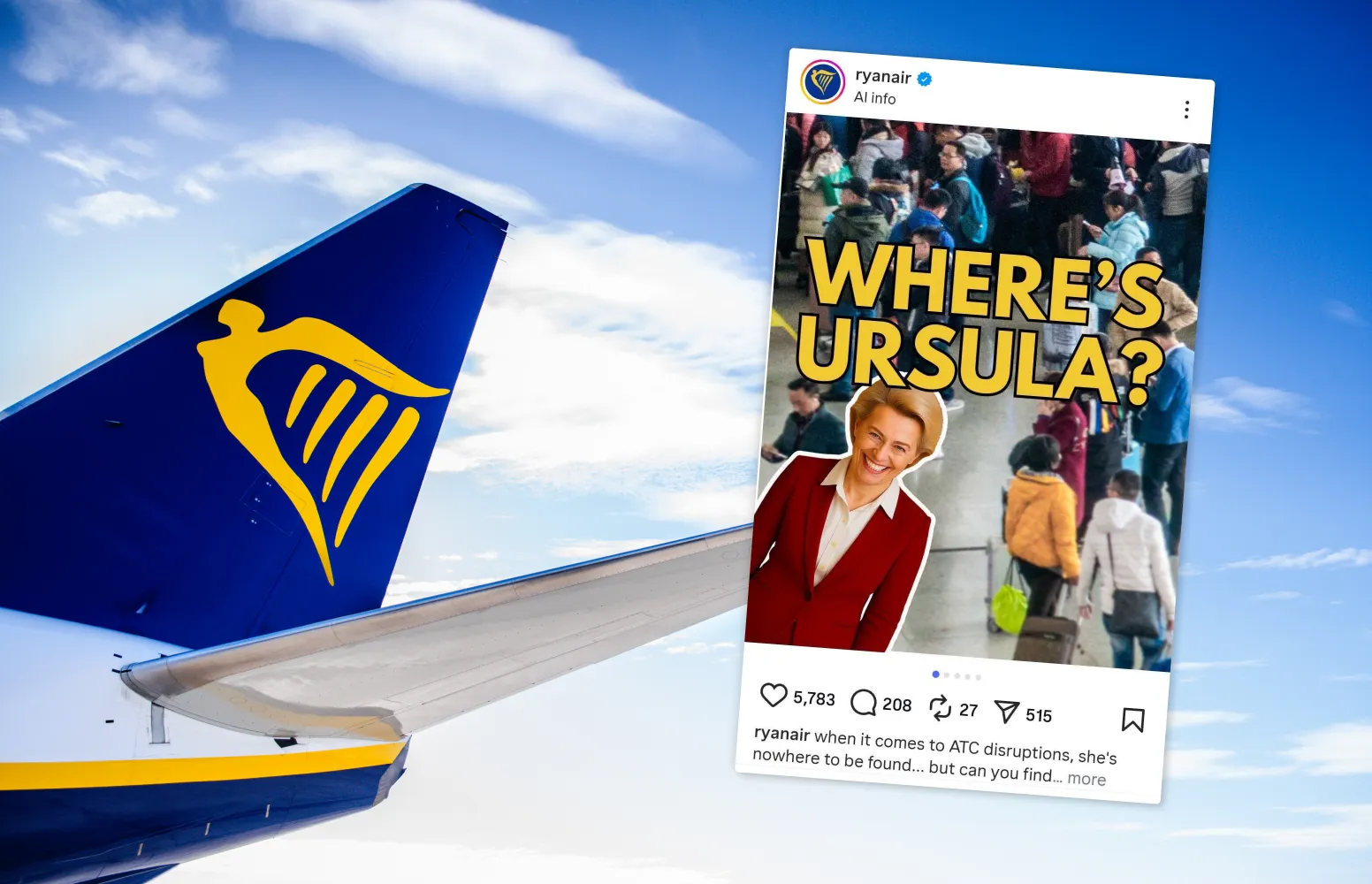
The president of the European Commission, Ursula von der Leyen, has long been a focal point of Ryanair’s narrative. After the ATC strike in France this year, Michael O’Leary called on Commission President Ursula “Von Derlayed-Again” to take urgent action to protect all EU overflights. But it is not just overflights. The airline often directs its critiques upward, demanding that she - or her institution - intervene.
von der Leyen, for Ryanair, represents EU inertia. The airline has accused her of hiding in her Brussels office while ATC disruption continued and overflight protection remained absent. In referencing her directly (e.g., “von ‘Derlayed’”), Ryanair personalises the conflict in a way that grabs headlines and frames the stakes politically. Targeting her also means targeting the Commission’s leadership, which Ryanair knows can raise the urgency of reforms beyond technical aviation circles into broader political debate.
Enjoying the article?
Follow us and never miss an update on the aviation industry.
Tactical Comms
Press releases are one of the weapons in Ryanair’s toolkit. The airline makes use of creative, visible channels to broadcast its grievances. Such tactics have helped the carrier to punch above its weight in public and political arenas.
One approach is campaign-style websites. After the July 2025 French ATC strike, Ryanair launched an “Air Traffic Control Ruined Your Flight” page listing national transport ministers and how many flights and passengers they had “caused” to be disrupted. That kind of public dossier pulls ministers into the frame. On its own digital platforms, Ryanair often uses notifications on its website, warning customers of potential disruption and attributing blame to ATC or government entities.
Social media is another vector. The airline posts high-visibility complaints, memes, graphics, metrics, and comparisons. It promotes ease of sharing and encourages passengers to pressure governments or regulators. Some posts single out officials, agencies, or firms for “delay times,” fee levels, or disruption.
Media relations are also prominent. Ryanair times statements to coincide with peak travel weeks, broadcasts the threat of large cancellations, and uses strong language to secure press coverage. The tactical timing of statements intensifies impact.
These communications do more than public relations. They influence regulators, national media, political actors, and industry stakeholders.
From Runways to Regulation
What lessons can aviation professionals and other airlines take from Ryanair’s loud and prominent stance? That a carrier can operate not just in airports and airspace, but in public debate and policy. Ryanair argues forcefully, and at times, provocatively, about issues ranging from ATC strikes and airport fees to Brexit border complexity and EU labour laws. In doing so, the airline seeks to shape its operating environment in its favour. For those inside aviation, that isn’t just drama - it’s a case study in advocacy, pressure, and positioning.