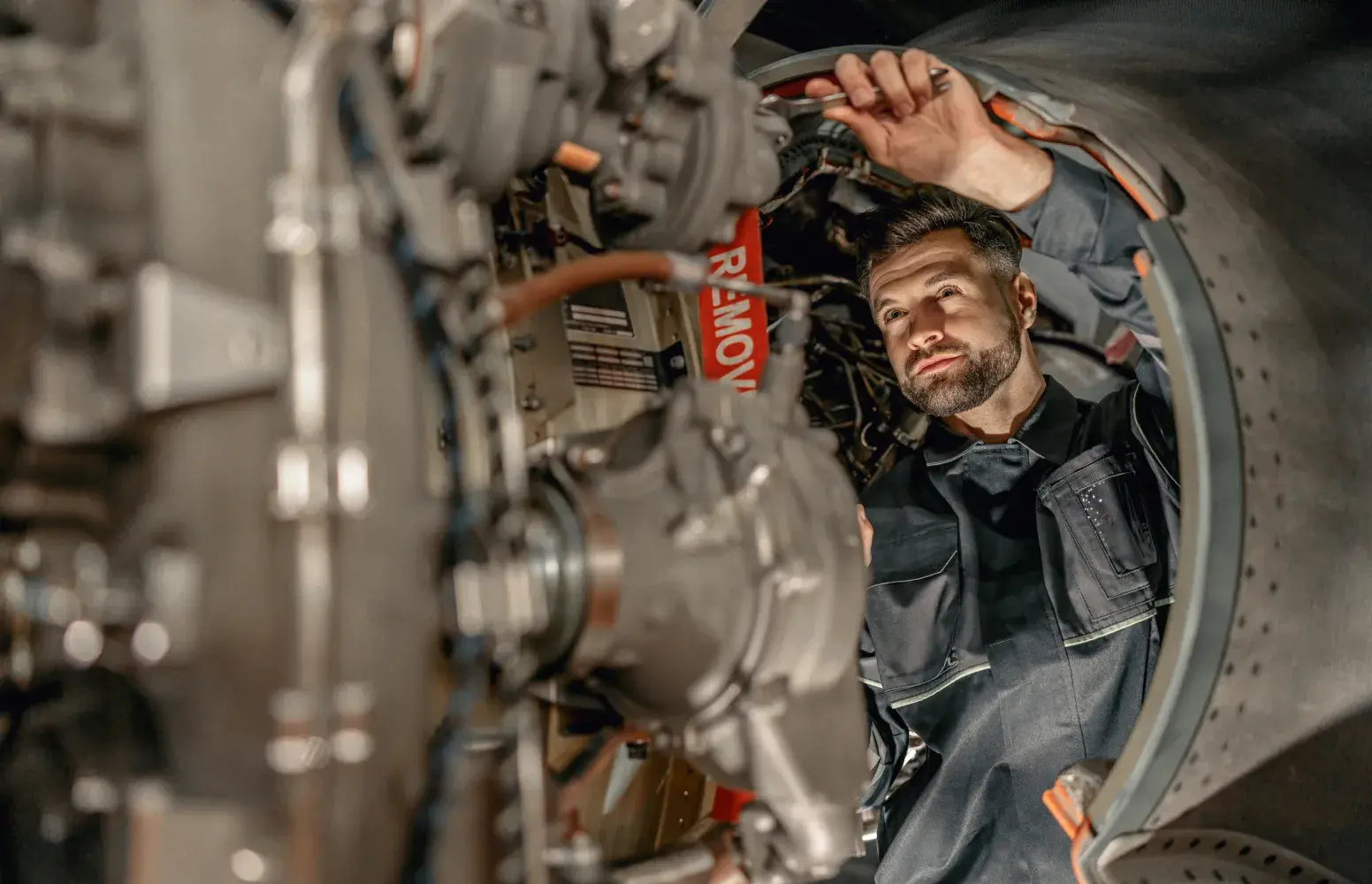
The aviation industry is undergoing a massive transformation, driven by demands for efficiency, safety, and maintenance. Aviation MRO (Maintenance, repair, and overhaul) has also moved away from manual repairs to a more automated process, which is improving turnaround time and aircraft airworthiness. In this mix, the role of aircraft mechanic has become even more crucial in ensuring that aircraft remain in optimal condition. If you are an aspiring professional in this field, now is the time to start preparing for aircraft mechanic interview questions to ace the interview and get the job.
1. Why do you want to work as an aircraft mechanic?
Among the many aircraft mechanic interview questions and answers, this will typically be the first one to be asked. While an easy one to attempt, it still demands a compelling answer that connects passion with responsibility.
Here’s how to answer:
A career as an aircraft mechanic lets me combine technical problem-solving with real-world impact. As an aircraft mechanic, even the most mundane task contributes to overall passenger safety and adds to the sense of responsibility and purpose. Moreover, I am drawn towards the complexity of aircraft, where the mechanical, electrical, and electronics systems have to work in tandem to power the machine. Troubleshooting and maintaining such machinery demands that I be both analytical and hands-on.
In addition to a rewarding career path, this role offers ample opportunities to grow technically and professionally while being part of a larger team that takes care of the aircraft fleet.

Posted 2 days ago

 Verified

Posted 3 days ago
Verified


Posted 22 days ago
Verified

Posted 6 hours ago
Posted 6 hours ago
Posted 6 hours ago
2. How do you ensure safety while performing maintenance?
Among the various aircraft mechanic interview questions, recruiters ask this question to evaluate your mindset and your focus on safety at every step of the process. Your answer should highlight how you emphasize discipline, awareness, and strict adherence to approved maintenance documentation and procedures.
Here’s how to answer:
Considering how regulated the aviation industry is, safety can never be put on the back foot. I make it a point always to follow the Aircraft Maintenance Manual (AMM) and never rely on assumptions or memory alone. Before starting a task, I follow a process which includes e proper isolation procedures, such as deactivating electrical systems or relieving hydraulic pressure. Additionally, I also utilize personal protective equipment (PPE) and verify that tools are in good condition.
In this line of work, situational awareness is critical. Which is why I am always mindful of my surroundings, especially when working in confined spaces or at heights. Safety also demands clear collaboration. I keep an open line of communication with team members, and this helps in preventing misunderstandings. In the end, safety is not just about avoiding accidents; it’s about maintaining a consistent, disciplined approach to every task.
3. What would you do if you found a defect that was not listed in the manual?
Some aircraft mechanic interview questions attempt to evaluate your judgment and how compliance-driven you are. There will always be unexpected incidents in this line of work. Your response to the situation can have a lasting impact on aircraft safety.
Here’s how to answer:
If I encounter a defect that is not covered in the maintenance manual, I will not try to run on assumptions and carry out unauthorized repairs. In such cases, it is always important to document the issue and report it to the supervisor. Once that is done, the next step is to involve the engineering support team, and in their unavailability, refer to additional documentation. If necessary, the issue may be escalated to the aircraft manufacturer for clarification.
Any corrective action needs to be approved and properly documented before proceeding. This is because if we act outside approved data, it will compromise safety, and we end up breaking aviation regulations. This approach ensures that the defect is handled correctly while maintaining compliance and preserving the aircraft’s airworthiness.
4. How do you handle working under pressure or tight deadlines?
Many aircraft mechanic interview questions and answers attempt to assess your adaptability. The aviation industry can be quite stressful due to its dynamic nature. Thriving in this work environment requires one to remain calm under pressure.
Here’s how to answer:
Working under pressure has become quite common in the aviation industry, which demands quick turnaround time. My approach is to stay organized and focus on tasks based on safety and operational impact. To do this, I break my tasks into manageable steps. The key is to complete them accurately one after another rather than rushing. For instance, if a deadline creates pressure that might potentially compromise safety or quality, I communicate this to my supervisor immediately. High-stakes situations require consistent communication with your team.
I have always found it helpful to rely on checklists. This helps me avoid missing critical steps. Unexpected situations and emergencies have taught me that it is always better to maintain composure and discipline than to go through tasks with speed. What matters is to complete tasks correctly rather than completing them quickly and making an error that might possibly derail further operations.
5. What is the importance of documentation in aircraft maintenance?
In the list of aircraft mechanic interview questions, such as this one, recruiters want to evaluate your regulatory understanding. This is because documentation in aircraft maintenance is a critical step and provides teams with a complete and transparent record of the work performed.
Here’s how to answer:
I believe proper documentation allows both engineers and inspectors to verify if the maintenance tasks have been completed according to approved procedures. Documentation also helps in tracking recurring issues and planning future maintenance. When records are not documented clearly and accurately, it can lead to serious safety risks as well as regulatory violations, all of which can have a massive impact on aircraft safety. This is why I ensure that my documentation is clear, precise, and completed after task completion. Ultimately, if it is not documented, it is not done.
6. How do you handle a maintenance error you discovered after signing off on a task?
Accountability and professionalism are two important caveats in any aviation role. In the many aircraft mechanic interview questions that the recruiter will ask, this particular one will be directed at understanding if you focus on reporting errors immediately, regardless of consequences.
Here’s how to answer:
I make it a point to first notify my supervisor or maintenance control. I also document any discrepancies and ensure that corrective action is taken before the aircraft is released for operations. The aviation industry is extremely regulated, where it is crucial to avoid concealment. Aviation relies on transparency and safety. I make it a point to follow the organization’s Safety Management System (SMS) and error-reporting procedures.
If I witness an error, I try to analyze its root cause, such as fatigue, misrepresentation, and procedural gaps. This helps me to take proper steps to avoid recurrences in the future. What is more important is to infuse a sense of responsibility and commitment to safety culture, rather than only focusing on one’s technical skills.
7. How do you interpret and apply maintenance manuals under time pressure?
Some aircraft mechanic interview questions asked by the recruiters attempt to evaluate a candidate’s focus on accuracy rather than speed while maintaining efficiency. It is important to highlight that the correct version of the manual is used during any maintenance procedure.
Here’s how to answer:
I begin by breaking down the entire process step-by-step while also cross-referencing diagrams, notes, and warnings. This step is critical to avoid misrepresentation. The objective is to always use the correct version of the manual.
In aviation, there will always be times of pressure. In such scenarios, it is important to prioritize critical steps. If I am unclear, I make it a point to consult a senior engineer for further support. I am also quite familiar with different document structures, such as AMM, IPC, and SRM. In the end, I always strive to balance operational demands with strict adherence to procedure.
8. How do you troubleshoot an intermittent fault in an aircraft electrical system?
Aircraft mechanic interview questions, such as this one, are asked by recruiters to analyze how data-driven your approach is. They want to know that you have a systemic approach to solving problems rather than relying on guesswork.
Here’s how to answer:
Before starting the task, I review the aircraft’s maintenance logs to understand past discrepancies. This helps in identifying patterns. I isolate the system by using wiring diagrams and fault isolation manuals (FIM). Once this is done, I perform continuity checks. Additionally, wiggle tests and thermal stressing can help reproduce the fault. In failures like this one, it is essential to use proper test equipment and avoid unnecessary component replacement. In the end, it is always better to prioritize safety and accuracy rather than speed.
Enjoying the article?
Follow us and never miss an update on the aviation industry.
Conclusion
Keeping aircraft ready for operation is not an easy task. But behind the success and longevity of each airplane is a dedicated team of aviation professionals working around the clock to ensure its top-notch performance. In this mix, aircraft mechanics are absolutely crucial. Explore our blog to learn more about the job description of an aircraft mechanic.
As global air travel demand increases, the need to maintain aircraft in peak condition will increase the number of aircraft mechanic jobs. Now is the time to get upskilled and prepare for the job interview that will get you your dream job.