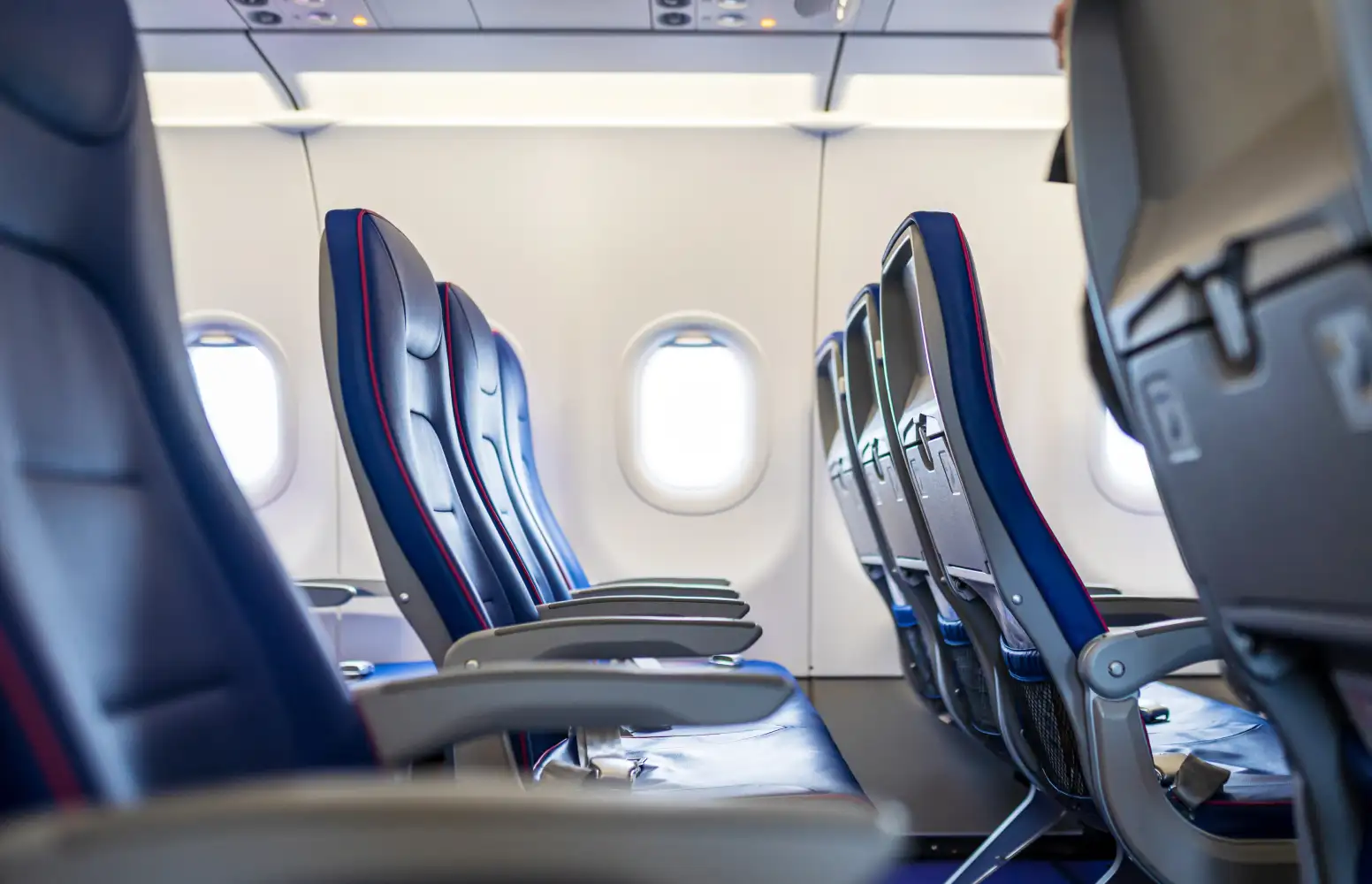
Following a successful trial across six of their bases, Wizz Air have announced they are now rolling out their ‘Wizz Class’ premium seating offering across its entire network. While Wizz Air's high-density cabins are designed for maximum capacity (and revenue), their ‘premium’ class offered passengers additional space without the need to reconfigure their aircraft by using seats with additional legroom (such as front row and emergency exit rows) and blocking off the middle seat.
Beyond this, Wizz Class bundles several of their most popular premium services into a single, higher-tier offering. Key components include:
- Priority Boarding (WIZZ Priority): This allows 'premium' passengers to board the aircraft first, providing quicker access to overhead locker space - a critical consideration on Wizz Air's carry-on heavy flights.
- A Larger Carry-on Bag: The package includes the allowance for a 10 kg (22 lb) carry-on trolley bag, alongside the smaller personal item that is standard with the basic fare.
- Dedicated Check-in: In markets where available, 'premium' passengers benefit from dedicated check-in desks, expediting the ground process.
Wizz Class passengers also receive a free snack and non-alcoholic beverage.
This unbundled yet packaged approach allows Wizz Air to charge a single, higher fare for the combination of comfort and convenience, without incurring the high additional costs or baked-in commitment associated with a full-service premium product, such as re-fitting cabins, logistical barriers and additional catering costs.
The pricing for this 'premium' option is dynamic and route-dependent, but the cost increase over a basic fare generally ranges from $45 (£33, €39) to $110 (£81, €95). This pricing sweet spot is calculated to capture the marginal revenue from passengers seeking a better experience without alienating the core budget customer or coming at the expense of the empty seat that is left between Wizz Class passengers.
The Full Network Expansion
The successful trial period has prompted the Wizz Air leadership to commit to a full-scale rollout, integrating the 'premium' offering across its entire network of flights.
The expansion will see the designation of specific seating blocks on all operational aircraft as 'premium' seats. Furthermore, the associated ground service benefits, such as priority access and check-in, will be implemented at all airports served by the carrier. This transition from a limited trial to a core product signals the confidence Wizz Air's management has in the revenue-generating potential of this offering.
Speaking on the expansion, Michael Delehant, Chief Commercial Officer at Wizz Air, highlighted the customer-centric reasoning behind the move. "Our passengers have consistently demonstrated a willingness to pay for convenience and comfort. The trial confirmed that this unbundled 'premium' product meets a distinct market need. By rolling this out across our network, we are not changing our DNA as an ultra-low-cost carrier; rather, we are enhancing our ability to maximise revenue per passenger while maintaining our industry-leading cost base."
The Chief Executive Officer, added; "This initiative is a critical component of our ongoing ancillary revenue growth strategy. In an increasingly competitive environment, Wizz Air must innovate beyond simple fare cuts. The 'premium' offering is highly accretive, leveraging existing cabin configuration with minimal modification. It is about offering the right product, to the right segment, at the right price point, consistently across all 100+ destinations."
This expansion is projected to contribute an additional $50 million (£37 million, €43 million) annually in ancillary revenue once fully implemented, underpinning the financial rationale for the decision. The uniform network-wide implementation is planned to be completed by the end of the second quarter of the current fiscal year.
How Wizz Class compares to other carriers
Wizz Air is not alone. Other LCCs, both in Europe and globally, have already experimented with similar forms of hybridisation, offering enhanced comfort and services. Understanding how Wizz Air's 'premium' stacks up is essential to evaluating its competitive advantage.
Ryanair's Plus and Flexi Plus
Ryanair, Wizz Air's main ultra-low-cost rival in Europe, offers two primary enhanced fare bundles: 'Plus' and 'Flexi Plus.'
Ryanair Plus: Typically includes a reserved standard seat, a 20 kg (44 lb) checked bag, and a small personal bag. This is mainly focused on checked baggage convenience.
Ryanair Flexi Plus: A higher tier that includes a reserved seat (including the extra-legroom seats), priority boarding, a small personal bag, and, critically, free flight changes. The flexibility element is the key differentiator here, targeting business passengers whose schedules often shift.
Wizz Air's 'premium' is more focused on the physical in-flight comfort (extra legroom seats are guaranteed as part of the base 'premium' offering) and immediate convenience (priority boarding and large carry-on). Ryanair's highest tier, Flexi Plus, heavily emphasizes flexibility, an option Wizz Air has kept separate. Wizz Air is selling physical space and priority; Ryanair is selling time and flexibility.
easyJet's upfront and Extra Legroom
easyJet, a more traditional LCC with a higher average fare than Wizz Air or Ryanair, focuses on selling seat location as a discrete ancillary.
Upfront Seats: Located in the first few rows for a faster exit.
Extra Legroom Seats: Located at the exit rows.
easyJet treats the seats as separate add-ons. Wizz Air's 'premium' is a more bundled approach that includes the seat plus priority boarding plus the larger cabin bag. The Wizz Air offering is a more integrated product, offering greater perceived value to the passenger who would likely purchase all these ancillaries separately on easyJet.
Transatlantic LCCs (e.g., Norse Atlantic)
For LCCs operating long-haul routes, the 'premium' product is far more comprehensive. Carriers like Norse Atlantic offer a 'Premium' cabin with dedicated, wider seats, greater recline, a high-quality food service, and typically a seat pitch around 96-101 centimetres (38-40 inches).
Wizz Air's product is significantly less luxurious, reflecting its short and medium-haul network. The comparison highlights that Wizz Air's product is a 'premium economy' in philosophy, applied to the short-haul low-cost model, rather than a true dedicated premium cabin. Its success is predicated on offering a noticeable upgrade in comfort for an affordable premium, a model that differs substantially from the expensive and logistics-heavy long-haul premium cabins.
In summary, Wizz Air's 'premium' offering is competitively positioned as an all-inclusive bundle that targets the most friction points of the LCC experience: lack of legroom, difficulty securing overhead space, and slow airport processing. By solving these issues with a single purchase, Wizz Air simplifies the booking process and maximises revenue.
Operational and Strategic Impact
The full network expansion of the 'premium' class is expected to have several key operational and strategic impacts on Wizz Air and the wider market.
Ancillary Revenue Growth: The primary financial driver is the maximisation of ancillary revenue. Ancillaries are often more profitable than base fares for LCCs. This bundled product simplifies the purchase path for high-value customers, encouraging a single, larger purchase rather than multiple small add-ons.
Operational Efficiency: The inclusion of priority boarding as a core part of the 'premium' package aids in faster turnaround times. By prioritising a cohort of passengers with a pre-booked position, Wizz Air can better manage the loading process and minimise delays, contributing directly to better on-time performance (OTP) and higher aircraft utilisation rates.
Market Segmentation: The 'premium' class allows Wizz Air to effectively target specific segments without altering its core service for the rest of the cabin. This includes small-to-medium enterprise business travellers, affluent leisure travellers, and high-frequency flyers. This segmentation is crucial for maintaining competitive edge against full-service carriers (FSCs) on shorter routes.
Future Product Development: The success of this current 'premium' model could pave the way for further product unbundling or more sophisticated offerings. For instance, Wizz Air could introduce a "Super Premium" that adds guaranteed Wi-Fi (if implemented) or a specific food and beverage voucher, demonstrating a staircase of product offerings.
This expansion is a clear signal that the future of low-cost aviation lies not in a race to the bottom on price, but in a race to the top on ancillary innovation and targeted comfort.
Other Wizz Air stories in the news
In addition to the expansion of Wizz Class, Wizz has been appearing in the news for other reasons; not always good ones either.
Wizz Becomes Most Complained About Airline, Overtaking Ryanair
Despite its well-received passenger enhancements like the 'premium' class, Wizz Air has recently faced significant scrutiny regarding its customer service and operational delivery. Reports indicated that the carrier had overtaken its long-time rival, Ryanair, to become the most complained about airline in the United Kingdom. This high volume of complaints largely centres on issues related to flight cancellations, delays, and the resulting complexities and length of time taken to process passenger refunds and compensation.
While the company focuses on generating higher revenue through enhanced offerings, a fundamental failure in basic service recovery can severely damage brand reputation, particularly as they seek to attract higher-spending passengers who arguably will have higher expectations.
Industry analysts suggest that operational reliability and effective complaint resolution are key metrics that differentiate a sustainable hybrid model from a purely cost-focused one.
Fighter Jets Scrambled Over Wi-Fi Name
A Wizz Air flight flying to Israel was caught up in a security scare when a passenger’s ‘joke’ wifi name resulted in the scrambling of Israeli Air Force (IAF) fighter jets to intercept and hold the aircraft outside of Israeli airspace before finally being allowed to land safely at Ben Gurion Airport.
The passenger on flight W95301 had changed his wifi name to the Arabic word for ‘terrorist’, seemingly as a joke, causing the intercept and subsequent delays as all passengers and luggage were screened at a remote stand once it touched down.
Wizz Air Applies to Fly to the USA
Wizz Air has applied to operate flights between the UK and the US “as soon as possible”, submitting a foreign air carrier permit application to the US Department of Transportation via its UK subsidiary. Approval would allow the low-cost carrier to launch transatlantic services under the UK–US Open Skies Agreement. Wizz Air said it intends to operate charter flights only, subject to regulatory clearance.
The application does not specify routes, launch dates or aircraft, though the airline’s incoming Airbus A321XLR fleet could support long-range operations. Wizz Air’s Hungarian unit previously sought US approval for cargo flights in 2022, an application rejected over safety oversight concerns.The move comes as Wizz Air reduces its Gatwick presence to cut costs, shifting capacity to Luton. The change will see 13 aircraft based at Luton and seven at Gatwick, with one aircraft relocating permanently as part of a wider profitability drive.
Wizz Air are recruiting pilots
Wizz Air are currently recruiting pilots including Direct Entry Captains and First Officers based in their Luton base and will be running a series of open days. For more information, visit their profile on Aviation Job Search.
Header photo: salarko (Adobe Stock)