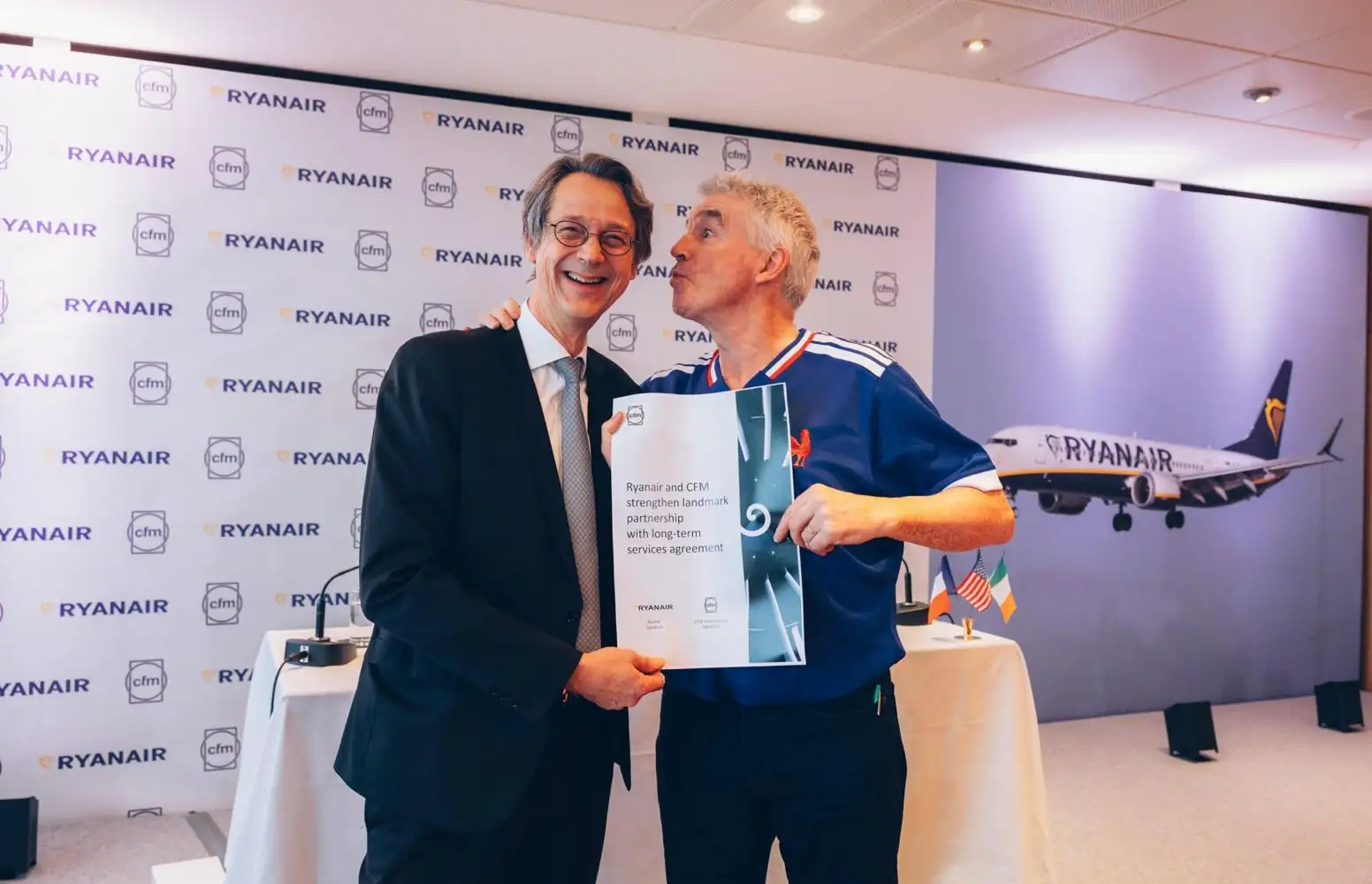
Low-cost giant Ryanair has signed a Memorandum of Understanding (MOU) with CFM International for a multi-year, multi-billion dollar engine material services agreement. This agreement, centred on Ryanair’s fleet of Boeing 737 Next-Generation (NG) and the newer 737 MAX aircraft, underscores the critical nature of engine maintenance and support in high-utilisation airline operations. It represents a significant commitment for both parties, securing a framework for the supply and maintenance of materials for the CFM56-7B and LEAP-1B engines that power the majority of Ryanair's fleet.
Ryanair looks to the future with CFM International
This MOU is not merely a supply contract; it establishes the long-term relationship essential for maintaining an airline of Ryanair’s scale. The CFM56-7B is fitted to the airline's extensive Boeing 737-800 fleet, while the LEAP-1B engines power the newest Boeing 737-8200 "Gamechanger" aircraft, which are fundamental to Ryanair’s current growth strategy.
For an airline known for its stringent cost control and operational efficiency, securing a stable and cost-effective engine services stream is paramount. The financial scale of the agreement, reaching into the multi-billion dollar figures, highlights the materials and services needed to support hundreds of engines over the coming years.
Speaking about the agreement, Ryanair Group CEO Michael O’Leary stated, "This extended partnership with CFM International is a crucial step for Ryanair as we continue to grow our fleet and passenger numbers across Europe. Having a robust, long-term agreement for the material services on our engines ensures we can maintain our industry-leading reliability and low-cost base. We rely on suppliers like CFM to support our operational model, which demands the highest standards of efficiency and turnaround times. This deal helps solidify that support for the foreseeable future, enabling us to keep our costs low and pass those savings onto our customers."
Olivier Andriès, CEO of Safran, said: “This new major milestone further strengthens the strategic relationship we have built with Ryanair over the past three decades, and we are proud to support their continued growth through this comprehensive MRO services offering. With the ongoing success of the CFM56 and the rapid growth of the LEAP fleet, we are investing to build a global MRO network within an open and competitive ecosystem to help our airline customers optimize fleet efficiency and control operational costs.”
Ryanair’s business model is fundamentally predicated on low costs and rapid aircraft turnaround. The airline often seeks deep, long-term relationships with key suppliers to leverage volume purchasing and secure fixed pricing or service level agreements that reduce financial uncertainty. This approach extends beyond aircraft manufacturers to essential maintenance and supply providers like CFM.
By securing this multi-year MOU, Ryanair is ensuring the necessary materials are available to their maintenance operations, which include both in-house capabilities and third-party MRO providers. The predictability of the supply chain is a substantial operational advantage, allowing for optimised maintenance scheduling and reduced Aircraft on Ground (AOG) situations, which directly impact profitability.
In-house vs OEM services agreements
Long-term engine services agreements are common practice across the global aviation industry, particularly among large fleet operators. However, the scale and focus of Ryanair's agreement reflects its unique position. Unlike some flag carriers or legacy airlines that may rely on original equipment manufacturer (OEM) support exclusively or have less control over their maintenance activity, Ryanair maintains substantial in-house engine MRO capabilities. The materials services agreement with CFM is designed to feed this internal operation, providing certified parts and repair materials directly, rather than solely outsourcing the labour and oversight.
For instance, major carriers operating Rolls-Royce or Pratt & Whitney powered aircraft also engage in comprehensive Total Care or similar programmes. These typically bundle maintenance, repair, and overhaul (MRO), often known as ‘Power by the Hour’ agreements, where the airline pays a fixed rate per flight hour for engine services. Ryanair's arrangement, focusing on the supply of materials, suggests a strategy to control the MRO labour and facility costs internally, using the CFM agreement to guarantee the quality and supply of necessary components. This method aligns with Ryanair's core principle of vertical integration where cost savings can be achieved.
Delta Air Lines, with its significant MRO division, Delta TechOps, is another example of a carrier that manages substantial maintenance in-house, balancing OEM support with their internal capabilities. The trend among large airlines to either develop or expand in-house MRO shops is driven by a desire for greater control over maintenance schedules, cost efficiencies, and capacity assurance, especially as engine shop visit backlogs grow globally. This MOU between Ryanair and CFM should be viewed through the lens of a carrier leveraging its size to secure preferential material supply while maintaining control over the MRO process. Other low-cost carriers in Europe, such as easyJet or Wizz Air, also have established agreements for engine support, but the size of Ryanair’s all-Boeing CFM fleet makes this particular deal exceptionally large and influential.
What it means for the engineering job market
The aviation job market, particularly within Maintenance, Repair, and Overhaul (MRO), is expected to see ripples from this kind of large-scale, long-term agreement across different areas.
For MRO, it creates increased certainty for long-term workload at both Ryanair's in-house facilities and contracted MRO partners, while across the supply chain it impacts the requirements for skilled logistics, inventory, and procurement professionals to manage the flow of materials.
Securing a multi-year materials agreement provides stability for Ryanair's maintenance schedule. This stability translates directly into job security and potential expansion within the airline's MRO shops located in key operational hubs. As the fleet grows and ages, the volume of engine shop visits increases, creating a sustained demand for highly skilled Licenced Aircraft Engineers (LAE) and technicians qualified on the CFM56-7B and, increasingly, the LEAP-1B engine. For entry-level candidates, this signifies a reliable career path into engine maintenance, a highly specialised and financially rewarding area of aviation MRO.
Furthermore, the complexity of managing a multi-billion dollar agreement requires robust supply chain and technical management. Roles in inventory control, procurement, and technical services will be essential to ensure that the correct materials are supplied on time and within budget. For those entering the industry in planning or logistics, such agreements generate guaranteed, long-term business requiring professional administration. The commitment to a specific engine type over an extended period allows MRO providers to invest confidently in tooling, training, and facility expansion, reinforcing the foundation for hundreds of jobs within the maintenance ecosystem supporting the airline.
This MOU, therefore, is not only a commercial agreement but a declaration of long-term operational plans that will sustain and potentially grow MRO employment in the regions where Ryanair and its partners conduct heavy maintenance.
Image: Ryanair