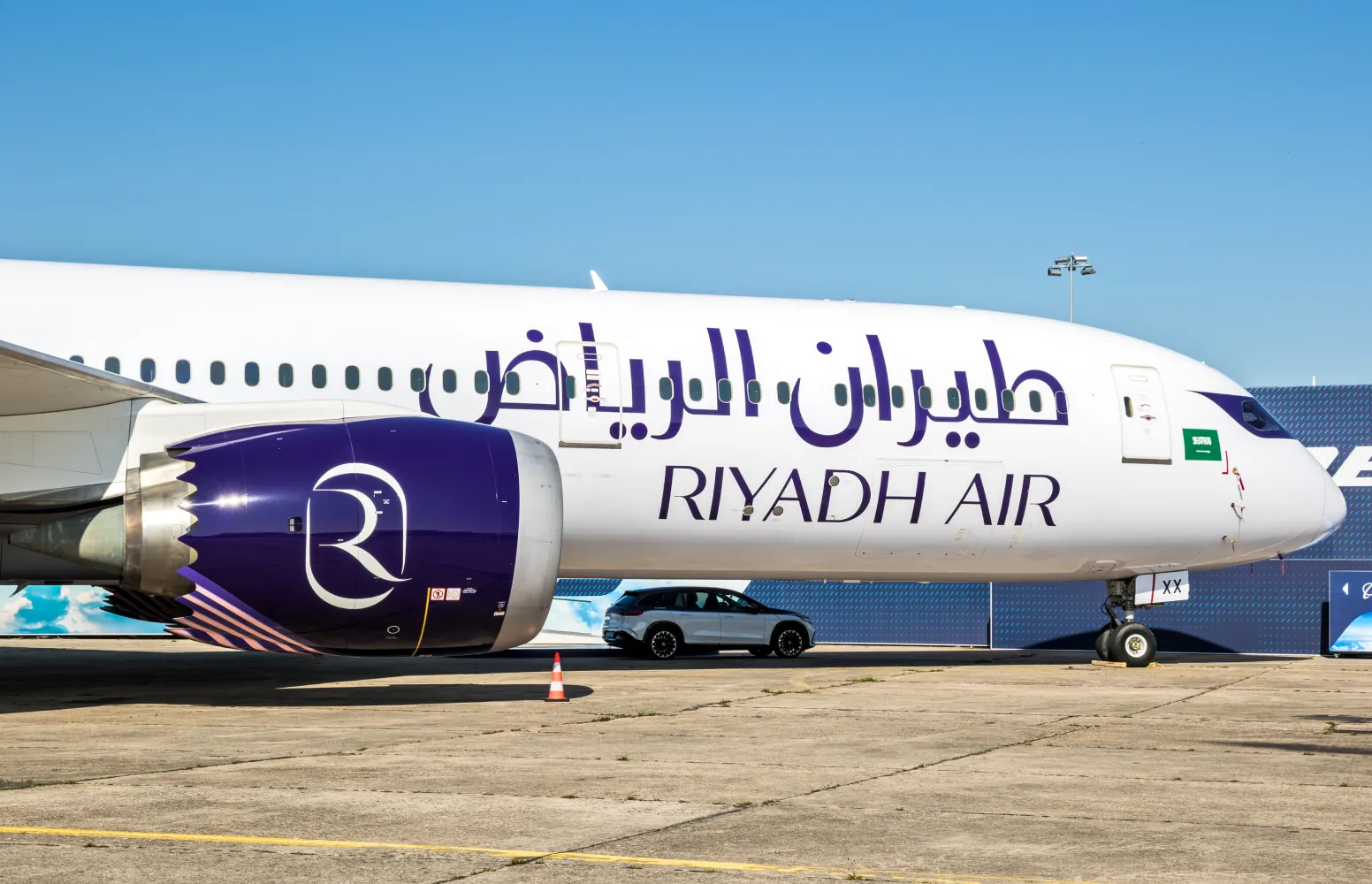
New carrier on the block, Riyadh Air, recently announced its first major fleet deal, a lease of Boeing 787‑9s with lessor AviLease. The delivery of the aircraft is scheduled for the final quarter of 2025. The airline’s first commercial route from Riyadh’s King Khalid International Airport to London Heathrow Airport (LHR) also took place on October 26th.
Both these developments carry significance for aviation professionals, especially those in the Gulf region, with new employment and career opportunities in one of the world’s most active aviation hubs.
Riyadh Air’s Operational Milestone
Riyadh Air’s recent agreement makes AviLease the inaugural lessor to partner with Saudi Arabia’s newest airline. The deal supports Riyadh Air’s strategy of building a young, fuel-efficient long-haul fleet. The Boeing 787 series, in this scenario, is well-suited for the operations, thanks to its wide-body cabin and efficient performance. For Riyadh Air, placing this asset ahead of a full commercial launch sends a message to both the market and prospective recruits that the airline is moving into the operational phase.
To commemorate the agreement, Adam Boukadida, CFO at Riyadh Air, was quoted, “We are pleased to complete our first aircraft lease with AviLease as we continue building a young, fuel-efficient fleet ahead of our commercial launch. The Boeing 787 is a highly capable aircraft that will play an important role in delivering a world-class travel experience for our future guests.” Edward O’Byrne, CEO of AviLease, also added, “Becoming Riyadh Air’s first leasing partner highlights the trust placed in AviLease and reinforces our position as a strategic enabler of the Kingdom’s aviation ambitions.”
From an industry careers viewpoint, a new wide-body fleet offers opportunities for multiple domains- pilots, cabin crew, maintenance engineers, flight operations specialists, and support staff. This milestone may signal recruitment activity ahead of a full schedule ramp-up.
Launching the London-Heathrow Route
Earlier in October, the carrier completed its maiden passenger flight. It flew from Riyadh King Khalid International Airport to London-Heathrow Airport. On board the flight were staff members of Riyadh Air and of the Public Investment Fund (PIF), the Saudi sovereign wealth fund.
The choice of Heathrow is notable: the London–Riyadh market currently carries high yields, driven by business travellers, diplomatic traffic, and premium traffic flows. By entering this major European gateway, Riyadh Air has positioned itself alongside established Gulf carriers, such as Emirates and Etihad.
Beyond the profitability of the route, an operation into a slot-controlled airport like Heathrow requires highly-skilled staff to maintain the standards of the airline. The breadth of roles stretches well beyond crew: operations control centres, regional sales teams, network planning, ground services, cargo logistics, and IT support will all need to scale.
Additionally, the London link places Riyadh Air in direct competition and partnership ecosystem with carriers such as Emirates and Etihad Airways, which already maintain a strong presence in London and the Gulf.
Shifting Dynamics in Gulf Aviation Jobs
Countries like the UAE, Qatar, and Saudi Arabia have traditionally dominated the Gulf aviation market, with Emirates and Etihad taking the top spot in the employment landscape. Riyadh Air enters this landscape with a sizable ambition. While the airline is based in Saudi Arabia, its ripple effects will touch the UAE labour market. Here are a few reasons why:
- Regional competition: As the airline develops, its infrastructure and network growth will increase traffic flows across the Gulf. Companies supporting Gulf-wide aviation often relocate to the UAE for economic or regulatory reasons. Riyadh Air’s expansion in Saudi Arabia can create spill-over job demand in UAE-based firms.
- Pilot and crew movement: Pilots and cabin crew often circulate among Gulf carriers. An expanding fleet at Riyadh Air means more opportunities for availability of roles in a region already familiar to UAE-based professionals. Some may choose to relocate to Riyadh or take assignments with partner carriers based in the UAE.
- Ancillary services: Riyadh Air’s growth will drive demand in training, simulators, ground-handling equipment, inflight services, catering, IT, and airport operations. Many of these service providers are UAE-based. The entry of a new major carrier will create additional demand for service supply and potential jobs.
- Competitive labour market: With a new carrier entering, other Gulf carriers may accelerate their own hiring or raise their employment benefits to retain talent. For entry-level candidates, this can translate into more choices.
For those in their early-career stages in aviation, the launch of Riyadh Air offers an interesting inflection point. Instead of only targeting UAE carriers, they might consider Saudi-based opportunities or positions supporting Saudi operations but based in the UAE region.
Getting Ready for the Hiring Wave
A few practical things to keep in mind if you’re early-career and keen to seize the opportunities this development might bring.
- Fleet type matters: The initial use of Boeing 787-9 entails the airline looking for pilots, maintenance engineers, and crew members with wide-body experience and long-haul service outlet preference.
- Timing of hiring: Although Riyadh Air has announced the lease and route start, full public ticket sales and full schedule ramp-up may trail these milestones. Hiring flows typically precede full operations. Keep an eye on the airline’s careers page and regional recruitment announcements.
- Training and certifications: Entry-level candidates should ensure they hold aviation-industry recognised credentials. Gulf carriers often look for international experience or strong language capabilities. Knowing both English and Arabic can set you apart.
- Regional mobility: While cross-border relocation is common, visa and employment contract terms differ. If you’re UAE-based now and considering a move to a Riyadh-based employer, evaluate relocation support, tax implications, and salary package for thorough comparison.
- Networking and supply-chain roles: Not all aviation jobs are onboard or cockpit. If you are in aviation IT, airport operations, ground services, or training-infrastructure, the ripple effect of a new carrier means additional contracts, new programs, and more junior roles opening up.
- Public launch vs operational readiness: While the publicly announced route to London and lease deal are positive signals, full staffing, fleet consolidation, and network build-out will take time. That gives early applicants a chance to engage now rather than decades later.
A New Player in Gulf Aviation
In the Gulf aviation ecosystem, UAE-based carriers like Emirates and Etihad have dominated for decades. Riyadh Air will join this space, but with a distinct national-carrier mandate anchored in the Kingdom’s broader economic strategy.
For UAE aviation professionals, this means more employer choices. With a new major carrier entering, UAE-based crews or engineers who may have previously considered only UAE carriers might expand their search regionally. Some roles at UAE carriers may relocate or evolve based on network changes caused by Riyadh’s expansion. Understanding how Riyadh Air interacts with Emirates, Etihad, and other Gulf carriers will be useful for career planning.
Employment in Saudi Arabia may differ from UAE norms in terms of tax, roster patterns, and cultural context. Candidates should compare offers based on total compensation rather than salary alone. Technologies and service standards may also shift. We are likely to see growth in roles like long-haul cabin crew, extended-range pilots, and premium product managers. For UAE professionals with long-haul experience, this could open new pathways.
Enjoying the article?
Follow us and never miss an update on the aviation industry.
Early-Career Strategies
It’s easy to assume that Riyadh Air will focus on hiring only experienced professionals. However, this assumption could make you overlook genuine opportunities—even if you’re new to the aviation field. What type of approach should early job seekers adopt for the next 12 to 18 months? For starters, it is crucial to monitor the Riyadh Air careers portal and Gulf aviation job-boards for roles labelled ‘graduate’, ‘trainee’, or ‘cadet’. Next, highlight flexibility for Gulf relocation, long-haul operation interest, and multicultural team experience in your resume.
If you are UAE-based now, consider shortlisting Saudi employment as part of your regional options. It is also vital that you develop skills aligned with modern long-haul operations, such as cabin crew training on Dreamliner (787) environments, engineers familiar with composite fuselage/787 systems, and pilots with multi-crew experience or readiness for wide-body transition.
The Gulf aviation employment landscape has always been competitive. While a new player like Riyadh Air changes the supply-demand profile, it also raises expectations on candidate readiness, safety culture, and service standards. As the airline prepares to ramp up operations, job openings across cockpit, cabin, engineering, operations, and support functions are likely to emerge.
In an industry where fleet type, route network, and employer reputation matter, viewing Riyadh Air as a viable option alongside Emirates and Etihad broadens the horizon. Entry-level candidates, as well as experienced professionals, who position themselves now with the right qualifications, flexibility, and Gulf-region awareness, may benefit from this new wave of aviation growth in the Gulf.