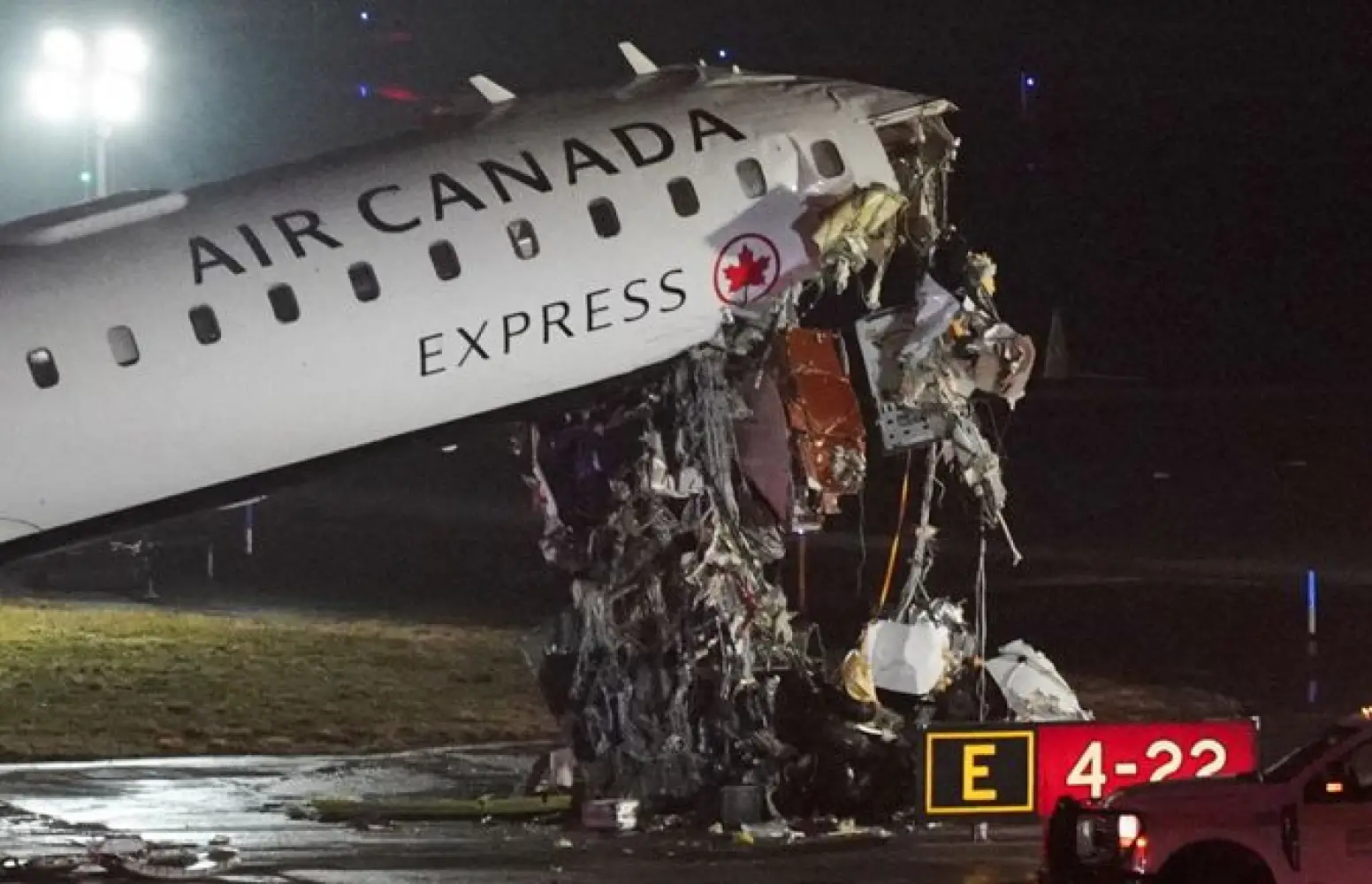
At 23:37 on Sunday, 22nd March 2026, Air Canada Express Flight AC8646 touched down on Runway 4 at New York LaGuardia Airport (LGA) after a routine one-hour service from Montréal-Pierre Elliott Trudeau International Airport. What followed in the next few minutes would close one of the United States' busiest airports for the better part of a day and claim the lives of two flight crew members.
The aircraft, a Bombardier CRJ-900LR registered C-GNJZ and operated by Jazz Aviation on behalf of Air Canada Express, was decelerating along the runway when it struck a Port Authority Aircraft Rescue and Fire Fighting (ARFF) vehicle near Taxiway E.
The ARFF truck had been cleared by air traffic control to cross Runway 4 at Taxiway D and was responding to a separate, unrelated incident (reports suggest another aircraft had reported an unusual odour in its cockpit). On Air traffic control audio captured by LiveATC.net, a controller can be heard issuing the crossing clearance, followed moments later by increasingly urgent commands to stop, before confirming a collision on the field.
The controller is heard saying "Truck One, stop, stop, stop!" before addressing the Jazz crew seconds later: "JAZZ 646, I see you collided with the vehicle. Just hold your position. I know you can't move. Vehicles are responding to you now."
LaGuardia Airport said in a statement that "Emergency response protocols were immediately activated," adding that "The Port Authority Police Department is on scene along with the agency's Chairman and Executive Director."
FlightRadar24 data recorded the CRJ-900's last ground speed as 21 knots (39 km/h, or approximately 24 mph), though the actual speed at the moment of impact is likely to have been considerably higher - CNN, citing law enforcement sources, reported the aircraft was travelling at around 30 mph (48 km/h) when the collision occurred.
The Aircraft and Those Aboard
Flight AC8646 had departed Montréal more than two and a half hours behind schedule, eventually pushing back at 22:35 and arriving at LaGuardia just over an hour later. The CRJ-900 involved is a 20-year-old aircraft that first entered service in 2005.
In its standard configuration, it seats up to 76 passengers across two cabin classes, with 12 seats at the front and 64 in economy. Jazz Aviation confirmed a preliminary passenger count of 72 passengers and four crew members, figures described as subject to confirmation.
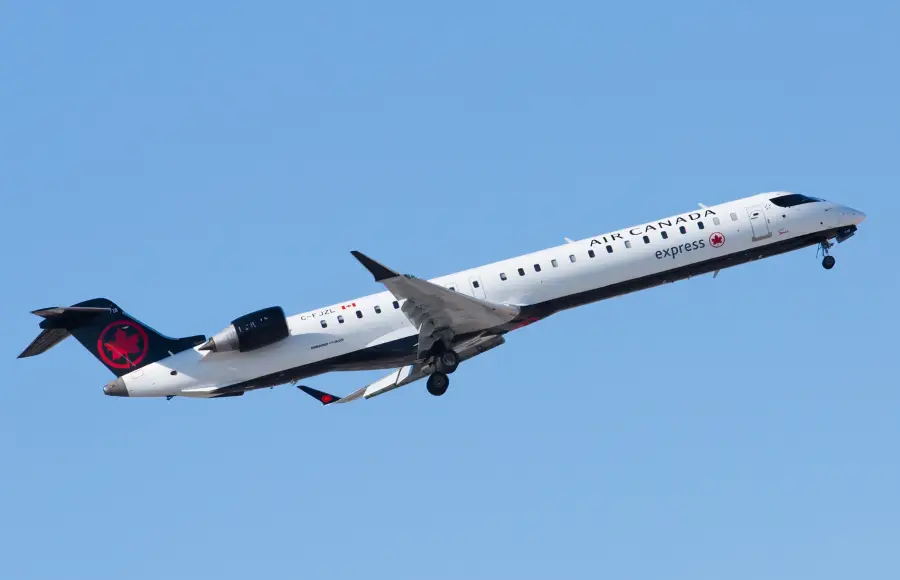 Image of similar aircraft courtesy of Carlos Yudica, Adobe Stock
The pilot and co-pilot were killed in the collision. The New York City Medical Examiner's office took over handling of their deaths, confirming the fatalities. Two Port Authority officers aboard the ARFF vehicle sustained broken limbs and were stabilised at the hospital. Preliminary reports indicated more than a dozen passengers suffered varying degrees of injury, though no additional fatalities among those on board have been confirmed at the time of writing.
Damage to the Aircraft
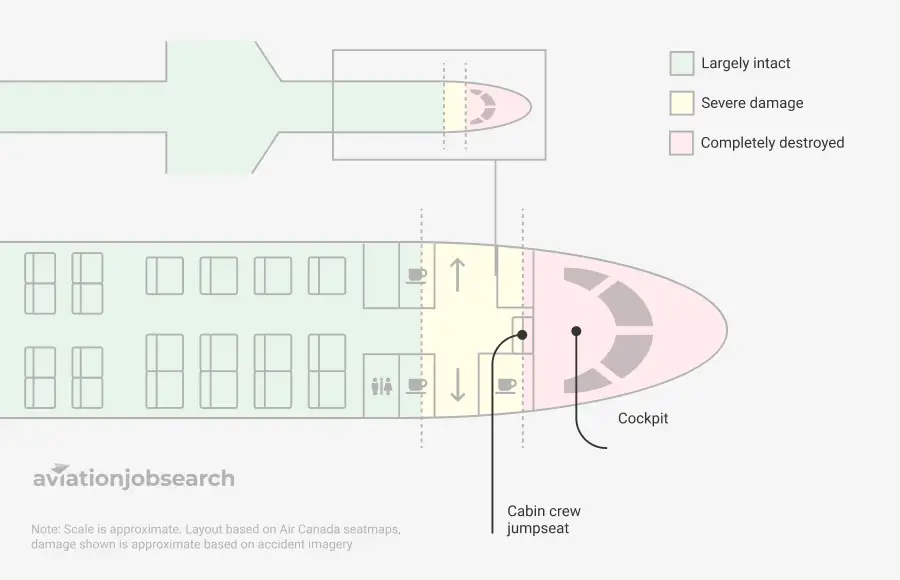
Photographs and video from the scene show severe structural damage concentrated at the nose and forward fuselage of the CRJ-900. The height differential between the relatively low-slung regional jet and the mass of a heavy ARFF vehicle meant the aircraft's cockpit bore the full force of the impact, with imagery showing the nose section tilted sharply and the cockpit area substantially compromised. This is consistent with the fatal injuries sustained by the two flight crew members positioned at the front of the aircraft.
The aircraft remains on the runway pending investigation.
Airport Disruption and Response
The FAA issued a ground stop at LaGuardia shortly after the collision, citing an aircraft emergency. The airport was officially closed at 03:16 on Monday, 23rd March 2026, and was not expected to reopen until at least 14:00 local time - meaning the facility was effectively out of action for much of the day. LaGuardia typically handles upwards of 400 flights daily, and the knock-on disruption to Newark Liberty (EWR) and John F. Kennedy (JFK), which absorbed diverted traffic, was significant. Passengers across the New York area were warned to expect widespread cancellations and delays.
Conditions on the night were not favourable. Light rain and fog were affecting the airport at the time of the incident, reducing visibility on the airfield. Whether those conditions contributed to any breakdown in situational awareness is one of many questions the NTSB will need to answer.
The NTSB confirmed it was launching a go-team to investigate, with members expected to arrive on site on 23rd March 2026. The FAA said it was also investigating. Air Canada and Jazz Aviation issued statements acknowledging the accident and noting that passenger and crew figures were preliminary.
The Wider Safety Picture
This accident sits within a broader series of serious aviation incidents in the United States over the past year, a period that has drawn sustained public and political attention to air safety. In January 2025, a mid-air collision near Washington killed 67 people when a passenger jet and an Army helicopter collided. That accident had already prompted renewed scrutiny of staffing at air traffic control facilities across the country.
This incident has drawn comparisons with other aircraft and ground vehicle collisions, most notably on 18th November 2022, when a LATAM Airlines Airbus A320neo struck a fire truck while accelerating for takeoff from Jorge Chávez International Airport in Lima, Peru. The aircraft was approaching V1 - the speed beyond which a rejected takeoff becomes dangerous - when it hit the ARFF vehicle.
The right main gear collapsed, the engine on that side was sheared off, and the wing struck the runway and caught fire. Two firefighters aboard the truck were killed, and a third died of injuries months later. None of the 102 passengers and crew were fatally injured, though the aircraft, a five-year-old A320neo, was written off - becoming the first hull loss of that type.
The CIAA investigation into the Lima accident found that the ARFF vehicles had entered the runway without proper authorization during a poorly coordinated emergency response drill. Communication between the airport operator and the ATC authority had been inadequate, with controllers notified of the drill only around an hour beforehand. Non-standard terminology used during radio communications was listed as a contributing factor.
Enjoying the article?
Follow us and never miss an update on the aviation industry.
Coordination Under Pressure
What makes the LaGuardia collision particularly significant is the reported circumstances under which the controller was operating. Reports suggest that they were managing both ground and tower positions simultaneously.
The audio record appears to show that the ARFF truck was issued a valid crossing clearance, which was quickly rescinded. ARFF vehicles, by their design, are built for rapid response. They are large, heavy, and carry substantial volumes of firefighting agent. When deployed to an active emergency, their crews are operating under urgency. The challenge for investigators will be to establish precisely how the conflict developed: whether it arose from a sequencing error, a breakdown in position monitoring, the demands of managing multiple simultaneous events, or some combination of all three.
The NTSB go-team will have access to air traffic control recordings, radar data, ARFF vehicle logs, the aircraft's flight data recorder and cockpit voice recorder, and witness accounts from those on board and on the ground. A preliminary factual report is typically published within 30 days; the full investigation will take considerably longer.
For those working in aviation - whether in operations, ATC, ground services, or flight crew roles - this accident is a sobering reminder that runway safety depends on the integrity of every link in a communication chain that, on a busy night at a congested airport, can be under considerable strain.
Header image: Sky News