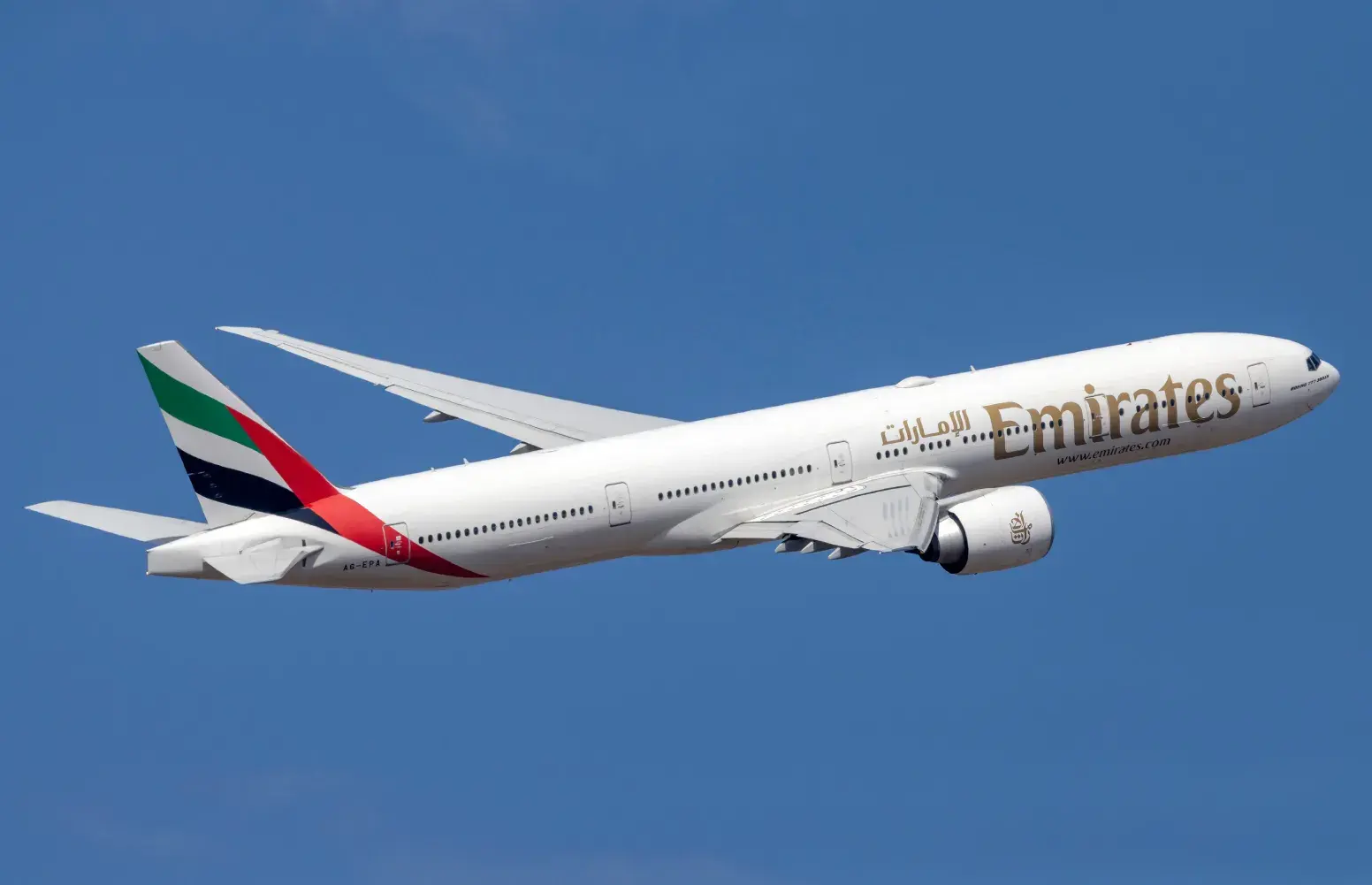
The Dubai Airshow opened on 17th November 2025 with an announcement that set the tone for the week. Emirates confirmed a $38 billion (£30 billion/ €35 billion) order for 65 additional Boeing 777X aircraft, a move that pushed the carrier’s future widebody commitments to a new level. The order includes both 777-9 and 777-8 variants and reinforces Emirates’ long-term plan to refresh its fleet with larger, more efficient widebody aircraft suitable for long-haul operations.
This year carried the same energy. The crowd had barely settled before the airline unveiled the deal, and although few looked surprised, many industry visitors reacted with quiet approval. Emirates has shaped a widebody strategy for decades, and its decision to scale up its 777X commitment again sent a clear signal about where it aims to go next.
High-Capacity Fleet for Expansion
The airline already operates the world’s largest fleet of Boeing 777 aircraft, so the decision to deepen the relationship further reflects its confidence in the platform’s next generation. The 777-9 will seat more passengers than the 777-300ER while offering lower fuel burn per seat, something major carriers have been chasing as international travel patterns continue to settle. Emirates has structured its long-haul network around high-density, long-range operations, and the 777X fits that model without forcing dramatic shifts in scheduling or maintenance planning.
If you look at the financial commitment, the scale alone speaks for itself. At $38 billion (£30 billion/€35 billion), it sits among the largest single announcements the show has hosted in years. Emirates often runs these deals to coincide with the airshow, but the volume of aircraft involved here stood out even to those accustomed to the airline’s pace of fleet growth. Conversations around the halls circled back to the same point: Emirates has doubled down on its belief that long-haul demand will hold through the late 2020s and into the next decade.
The airline stated that the extra capacity will support plans to introduce new destinations and add frequencies on established trunk routes. It was rumoured that Emirates had been modelling various long-term scenarios that required high-capacity aircraft with strong performance in hot conditions. The 777X family suits operations out of Dubai, especially during peak summer when temperatures place extra stress on aircraft during take-off.
Shift Toward a Boeing-Heavy Fleet
Another detail that caught attention is the fleet mix shift. Emirates continues to take delivery of Airbus A350 aircraft, and the progress of its A380 refurbishment programme shows it is not moving away from a multi-type strategy. Still, the new 777X order tilts the long-haul future of the airline toward Boeing noticeably.
For engineers, planners, and technicians, a move toward uniformity in one part of the fleet usually brings workflow benefits. Training becomes more predictable, spare parts planning becomes easier, and long-term maintenance forecasting gains stability.
The 777X still awaits full entry into service, so the order also serves as a show of trust in Boeing’s programme timeline. Industry discussions often circle delivery forecasts, certification progress, and how carriers interpret risk. Emirates' choosing to expand its commitment suggests that it has either received assurance on milestones or believes the long-term operational advantages outweigh potential scheduling concerns.
Many analysts pointed out that Emirates has the leverage to manage fleet gaps through its existing 777-300ER and A380 aircraft, giving it breathing room while waiting for the 777X to enter full service.
From a workforce perspective, a fleet renewal of this scale provides stability. Airlines planning with 20 to 30 year horizons create predictable demand for pilots, technicians, avionics specialists, engineers, planners, cabin crew, and operational staff. In aviation employment circles, announcements of this type often lead to fresh interest in training programmes and mid-career transitions. A few recruitment managers I know mentioned that whenever Emirates makes a large fleet order, applications from across the sector usually rise for several weeks. Long-term aircraft investment often signals long-term hiring needs.
Enjoying the article?
Follow us and never miss an update on the aviation industry.
Efficiency Gains
For Boeing, the order strengthens its position with one of its most significant customers. The 777X has encountered delays, but Emirates' expanding its commitment offers reassurance at a moment when widebody competition is strong. The Airbus A350-1000 remains a serious contender for many carriers, so locking in repeat business from Emirates helps Boeing stabilise production targets and secure future work for its supply chain. Production of a new widebody family feeds thousands of jobs across multiple regions, so announcements like this carry industrial effects far beyond the UAE.
During the press briefing, Emirates emphasised that the order aligns with its long-term environmental targets. The airline pointed to the projected fuel efficiency improvements of the 777X, which will offer lower emissions per passenger. While this reflects broader industry pressures, it also brings cost savings.
Emirates has always built its model around high aircraft utilisation and long stage lengths, and even small efficiency gains become noticeable when multiplied across extensive networks. The 777-9 promises improvements that can support these goals without compromising capacity. The order linked Emirates’ past with its future, pairing the airline’s established 777 operations with the next major iteration of the type.