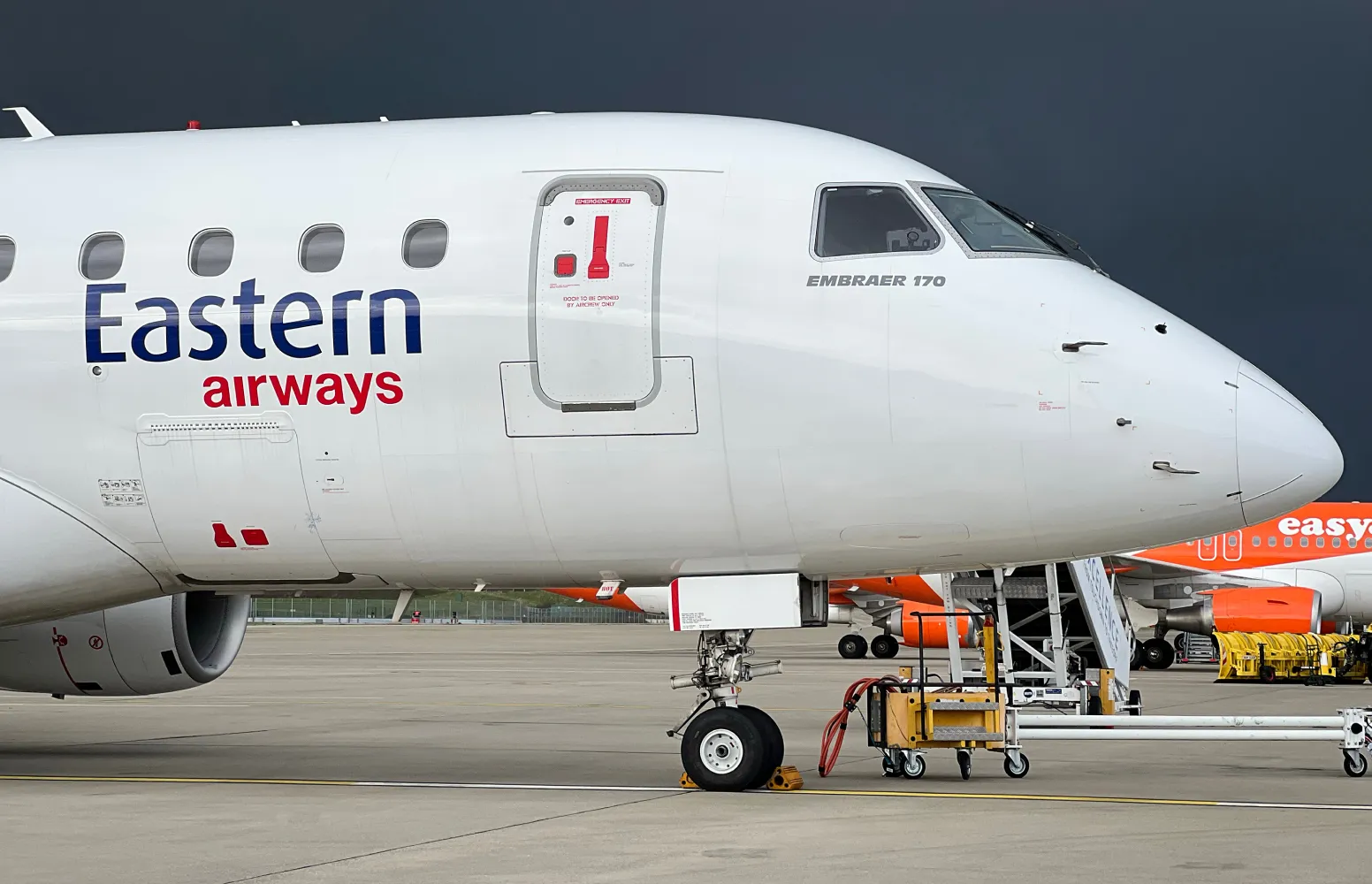
UK regional airline Eastern Airways has suspended all operations and is on the brink of collapse, putting scores of jobs at risk. On October 27th, the carrier filed a notice of intention to appoint an administrator after several flights were cancelled. Selina Chadha, CAA consumer and markets director, urged the airline’s customers to visit the regulator’s website for more information. She added, “We urge passengers planning to fly with this airline not to go to the airport as all Eastern Airways flights are cancelled.”
For many working in operations, crew, maintenance, or support roles, the collapse of Eastern Airways offers both caution and insight.
How the Collapse Unfolded
Established in 1997, Eastern Airways operated regional routes across the UK, Ireland, and Europe. The airline also ran subsidized services backed by the Scottish government connecting Aberdeen with Wick, John O’Groats, a lifeline route for residents in the northernmost part of mainland Britain.
Financially, in the year to 31 March 2024, the company posted a net loss of about £19.7 million, and its debts stood at around £26 million. A key trigger was the termination of its capacity-partnership with the Dutch airline KLM, leaving Eastern with high fixed costs and no ready replacement contract. The administrator described the situation as “unsustainable”.
The immediate consequence was staff redundancies, with 330 personnel according to the administrator, and the loss of operations. On the regional side, airports such as Cornwall Airport Newquay started urgently seeking replacement carriers.
From Partnership Loss to Financial Trouble
Eastern and KLM had a wet-lease/capacity partnership, where Eastern operated regional jets on behalf of KLM’s Cityhopper division. When KLM terminated the contract, the aircraft and crew remained part of Eastern’s cost base.
For regional airlines, wet-lease or ACMI (Aircraft, Crew, Maintenance, Insurance) contracts provide predictable revenue, but they also impose fixed cost obligations (crew rosters, aircraft leases, maintenance). While Eastern’s contract with KLM helped Eastern to operate a wide range of links from British cities to Amsterdam Schiphol on the Dutch airline’s behalf, the arrangement ended on 5 October. In Eastern’s case, the timing and scale of the contract loss appear to have tipped it past its margin threshold.
In addition, the airline had public-service obligation (PSO) routes like Newquay-London and Wick-Aberdeen, which are lower-yielding and reliant on subsidy. When the higher-yield KLM business disappeared, the business mix skewed further towards lower margin segments. Thus, the termination of the KLM contract was more than a lost customer: it fundamentally altered the economics of the airline’s fleet and resources.
A Difficult Year for Low-Cost Airlines
It has been a turbulent year for low-cost airlines, especially in Europe.
- Icelandic low-cost carrier, PLAY Airlines, ceased operations on 29 September 2025. This came after a business model twist, a shift away from trans-Atlantic routes and growing losses in the prior year. PLAY’s issue was over-ambitious expansion, reliance on fuel and currency exposure, and a small home market.
- Sweden’s Braathens International Airways filed for bankruptcy in late September 2025, citing liquidity problems, high fleet costs (Airbus jets for charter operations), and a failure to secure bridge financing.
- Ryanair’s CEO, Michael O’Leary, has recently been vocal about the state of low-cost airlines, predicting that Wizz will also collapse, and that easyJet will be sold off in parts; however, he has been saying this since 2021.
While PLAY and Braathens struggled with business model viability and demand, Eastern shows how a regional carrier’s dependency on a major partner can compound risk. The lessons differ: it is less about over-expansion and more about dependency and fixed cost mismatch.
In terms of staff impact, all three cases show abrupt job loss. But since regional connectivity is already under pressure in the UK, Eastern’s labour pool of pilots, cabin crew, and ground staff may face fewer immediate re-hiring opportunities in comparable roles. So for aviation professionals, Eastern’s case may carry greater personal risk.
How Staff Can Manage the Fallout
Here are a few immediate steps that Eastern’s staff can take to mitigate the losses.
- Confirm your employment and redundancy status: Ask for written confirmation of your employment end date, your rights to unpaid wages, holiday pay, and pension entitlements. Keep records of payslips, rosters, and correspondence.
- Explore job market opportunities: Regional and charter carriers with wet-lease and ACMI operations may be recruiting. It is vital to update your CV, emphasizing your flexibility, transferable experience, and geographic mobility.
- Check your certification and licences: Make sure your pilot licence, type ratings, cabin crew licences, and engineer licences are current. If you have training or endorsements that can be refreshed, do so earlier rather than later.
- Review contractual implications: If the company enters administration, there may be claims deadlines for unpaid wages, notice pay. In the UK, you may be able to claim via government-backed schemes.
- Think about broader career options: Use the pause to upskill or shift roles, such as ground operations, network planning, training roles, or ground handling. These roles are typically less volatile. Diversifying your role reduces exposure to a single carrier’s collapse.
- Leverage your network: Reach out to recruiters, former colleagues, and industry forums. Given the collapse was well-publicised, many carriers will be aware of the available talent pool.
- Maintain mental and financial preparedness: While this is a professional discussion, keep in mind the disruption of abrupt job loss. Have contingency for short-term finances. Recognise that the next role might require relocation or a lateral move.
Enjoying the article?
Follow us and never miss an update on the aviation industry.
Wrapping Up
The demise of Eastern Airways highlights how even established regional carriers are vulnerable if key contracts vanish and cost bases remain high. For aviation professionals working in the sector, these events are reminders to assess employer risk, maintain skills and agility, and plan for alternative options. The termination of a major customer contract adds a layer of risk that is less publicised than market collapse or over-expansion, but just as critical. Staff who act early, keep qualifications current, and diversify their career options are best placed to navigate the fallout.
Photo: photogoodwin - stock.adobe.com