
Aviation MRO has a critical role to play in the proper upkeep of aircraft. Among the various roles that make up this sector is the role of an avionics technician. An avionics technician plays a key role in keeping an aircraft’s electronic and electrical systems safe, reliable, and operational. As a result, employers look for the avionics technician resume that clearly demonstrates both technical expertise and practical aviation experience.
A well-written avionics technician resume should not just be a list of jobs. It should be a factsheet of one’s professional journey. It should highlight your aircraft experience, technical skills, certifications, licenses, maintenance knowledge, and ability to diagnose and resolve complex issues.
Whether you are a fresher looking for your first role or a seasoned professional, it is important to tailor your resume to the role. In this guide, we explore the essential sections to include and share practical tips for creating a professional avionics technician resume.
How to Write an Avionics Technician Resume
Before moving to what an avionics technician resume must have, it is important to understand the essentials one must keep in mind when writing one. Ultimately, recruiters should be able to quickly identify your qualifications, aircraft experience, certifications, and key skills.
- Most avionics technician resume examples use a professional, reverse-chronological format. Your most recent role should be the starting point as you move backwards through your employment history. Use clear section headings and concise bullet points rather than lengthy paragraphs.
- Next is to tailor each job to the job description at hand. Identify the aircraft types, avionics systems, certifications, tools, and technical skills mentioned by the employer and highlight the qualifications you genuinely possess.
- Your avionics technician resume must enlist specific achievements rather than enumerating your responsibilities. Where possible, use numbers to demonstrate the scale or impact of your work.
- Your resume should also prominently feature relevant licenses and certifications. For example, include an FAA certification, EASA Part-66 license, or DGCA AME license depending on your qualifications and location.
- End it with thorough proofreading. Consistent formatting, accurate technical terminology, and concise language can make your experience easier for recruiters.

Posted 12 hours ago

 Verified

Posted 10 days ago
Verified

Posted 14 days ago
Verified

Posted 14 days ago
Verified

Posted 21 days ago
Verified


Posted 5 days ago
Essential Sections of the Resume
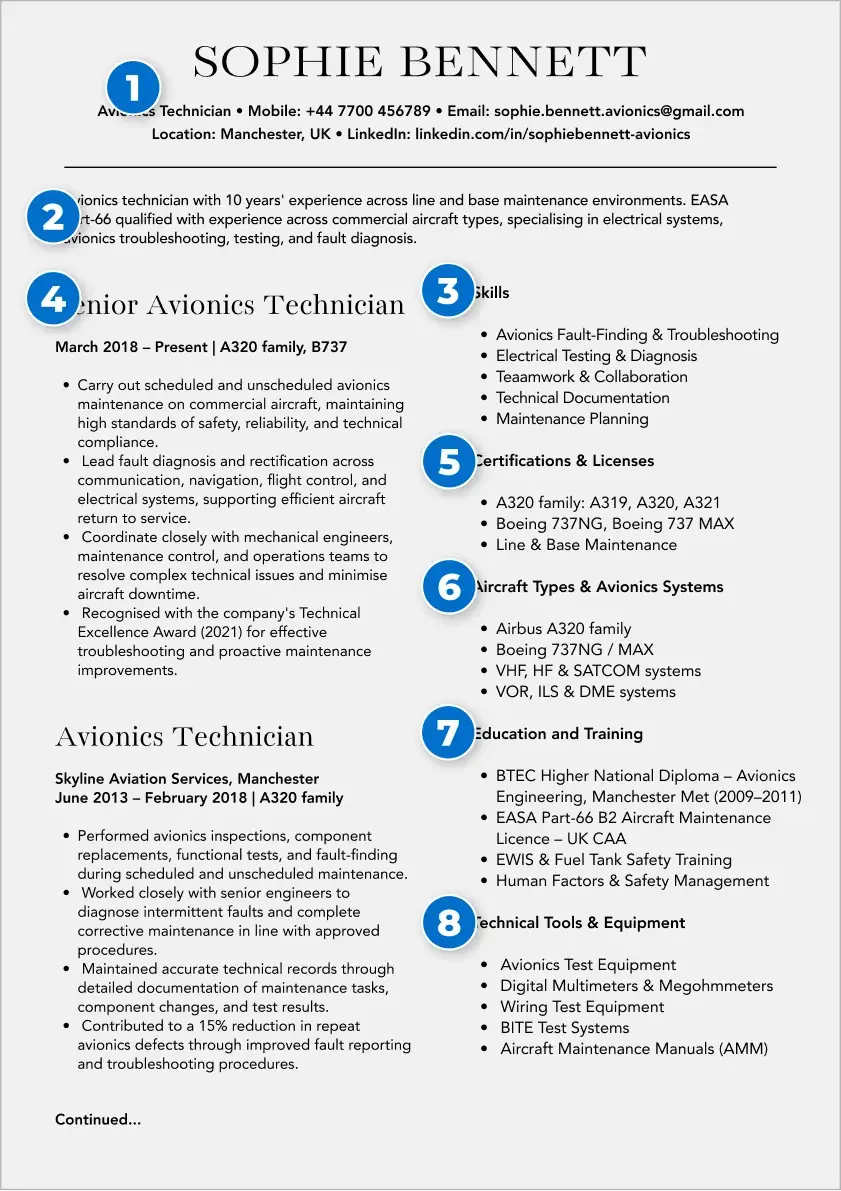
A strong avionics technician resume must present your qualifications and experience in a format that is easy to skim through. This is because recruiters only spend a short time reviewing a resume initially. Important sections in this case include licenses, certifications, aircraft experience, and technical skills.
1. Contact Information
Your avionics technician resume must start with the basic contact details at the top. It should be quick to scan. This section usually consists of your full name, phone number, professional email address, and location.
You generally do not need to include unnecessary personal information such as your marital status, date of birth, or full residential address unless the employer specifically requests it.
2. Professional Summary
Most avionics technician resume examples highlight a small section which provides an overview of your career journey. Aim for three to four lines that cover your years of experience, area of specialisation, aircraft types you have worked on, and key technical strengths.
For instance, one can include expertise in aircraft electrical systems, avionics troubleshooting, maintenance, and fault diagnosis.
3. Key Skills
Your avionics technician resume should also have a section to list the skills most relevant to the position. This should be a blend of technical and interpersonal skills. The thing to keep in mind is to tailor the skills to the requirements of the job wherever possible.
Technical skills include areas such as avionics troubleshooting, aircraft electrical systems, navigation and communication systems, wiring, testing, and preventive maintenance. Interpersonal skills include communication, teamwork, problem-solving, attention to detail, time management, and the ability to work under pressure.
4. Professional Experience
The next section is the professional experience section. As mentioned before, you must list this section in reverse chronological order, starting with your most recent position. Include your job title, employer, location, and employment dates.
It is crucial that each job listing focuses on achievements, projects, responsibilities, and technical work. While listing duties, explain the avionics systems you worked on, faults you diagnosed, and maintenance activities you performed.
5 Certifications and Licenses
A winning avionics technician resume must contain certifications and licenses related to avionics maintenance. Depending on your location and career background, you may include relevant credentials. Some examples include FAA certifications, EASA Part-66 license/categories, DGCA AME license, and many other relevant aviation maintenance certifications.
6. Aircraft Types and Avionics Systems
While not a mandatory section, it can be helpful to add a dedicated section for aircraft and avionics experience. Avionics technician resume examples have this section as it allows recruiters to quickly determine whether your background matches the employer's requirements.
You can list aircraft such as the Airbus A320 family, Boeing 737, and ATR 72. Along with this, you can also mention systems, such as communication and navigation systems, flight management systems, weather radar, instrumentation, and autopilot systems.
7. Education
Include your relevant educational qualifications, beginning with your highest or most recent qualification. Depending on your background, this could include a diploma, degree or technical qualification in avionics, aircraft maintenance, aviation electronics, electrical engineering, or a related field.
8. Technical Tools and Equipment
This section in your avionics technician resume will demonstrate your practical experience with the equipment and technology used in avionics maintenance.
Some examples include digital multimeters, oscilloscopes, avionics test sets, wiring testers, diagnostic software, maintenance software, and electronic test equipment.
Common Mistakes to Avoid
While you research avionics technician resume examples, it is important to know what mistakes to avoid. Even with strong technical experience, avoidable resume mistakes can make it harder for recruiters to understand your qualifications.
- Same resume for every job: A well-written avionics technician resume is one that is adjusted to every job description. Review the job description and emphasise the aircraft types, avionics systems, technical skills, and certifications that are relevant to the specific position.
- Burying certifications: Your licenses and certifications highlight your expertise. Don't hide them at the bottom of your resume.
- Listing duties without achievements: Your work experience must be quantifiable in your avionics technician resume. Describe specific maintenance activities, troubleshooting tasks, projects, or improvements, and include measurable results.
- Failing to mention aircraft experience: It is important to mention specific aircraft types that you have worked on. This can help potential employers quickly assess how well your experience matches their expectations.
- Using technical jargon: While technical knowledge is required, excessive jargon can make it difficult for recruiters to read your resume.
- Ignoring Interpersonal Skills: Avionics technicians often work alongside engineers, maintenance teams, and other aviation professionals. It becomes crucial that one is good at interpersonal skills like communication, teamwork, problem-solving, and attention to detail.
Tailoring Your Resume to a Job Description
While you go through avionics technician resume examples, it is important to keep in mind that your resume must be tailored for the JD in hand. So, how can you ensure this? Start by highlighting the essentials of a JD. This includes qualifications, aircraft types, avionics systems, technical skills, licenses, and certifications.
It is crucial to adjust your professional summary to emphasize the experience that complements the position. For instance, if a JD seeks someone with experience in aircraft electrical systems, your summary should put that to the forefront.
Next is to include the certifications and licenses that complement the role you have applied for. Include relevant credentials such as FAA certifications, EASA Part-66 categories, or a DGCA AME license, where applicable.
Most companies now use application tracking software (ATS). It is important to use the correct keywords in your avionics technician resume. Using relevant terminology from the job description can help ensure your resume clearly reflects your qualifications. However, only include keywords that accurately describe your skills and experience.
Since avionics technicians can work in both line maintenance and base maintenance, it is important to both mention and understand the areas. Mention line and base maintenance experience under the Professional Experience or Aircraft & Avionics Systems section. If you want to explore more about this topic, explore our blog on line maintenance vs base maintenance.
Enjoying the article?
Follow us and never miss an update on the aviation industry.
Conclusion
A well-structured avionics technician resume should help you present your professional journey clearly to potential employers. Whether it is your technical knowledge, credentials, key skills, or tools, every section should demonstrate why your background is relevant to the position.
Globally, we will see a growth in the number of avionics technician jobs. According to the U.S. Bureau of Labor Statistics (BLS), the avionics technician role will see a 6% employment growth from 2025 to 2035, which is faster than the average for all occupations. For those seeking employment in this area, now is a good time to brush up on key areas and get their avionics technician resume in order.
As we move forward, the demand for skilled talent will go up. Key factors driving up the demand include the rapid shift toward advanced digital glass cockpits, connected aircraft health monitoring, and a strong global demand for skilled maintenance professionals. If you want to learn more about what the role is all about, explore our blog on the job description of an avionics technician.