
Did you know that the global demand for aerospace engineers is expected to expand by about 6% to 8% through 2035? The growth of aerospace engineering as a career is strong and steadily growing. For aspiring professionals, now is a good time to start preparing for the role. Helping you with this is a well-written resume. Going through aerospace engineer resume examples can help you make a strong first impression and demonstrate why you are a good fit.
Thorough research of aerospace engineer resume examples is required for anyone, from a recent graduate searching for their first opportunity to an experienced professional. Your resume should clearly present your technical expertise, engineering knowledge, professional experience, and relevant achievements.
In this guide, you will find a sample resume for aerospace engineer, along with practical tips on structuring each section.
Essential Sections of an Aerospace Engineer Resume
A sample resume for aerospace engineer will tell you how the resume must allow recruiters to quickly identify your technical expertise, professional experience, and suitability for the role. While the exact format can vary depending on your experience level and the position you are applying for, certain sections are essential for most aerospace engineering resumes.
Essentially, each section should provide a balanced overview. This includes engineering knowledge, technical skills, software proficiency, career history, education, and relevant certifications.
1. Contact information
Most aerospace engineer resume examples have a header that has the basic contact details. This helps recruiters to easily reach you. This includes your full name, phone number, professional email address, location, and LinkedIn profile.
It is important to keep the section concise and professional. A sample resume for aerospace engineer will show the same. Make sure your email address is appropriate for job applications and that your LinkedIn profile is updated.
2. Professional Summary
The next section in most aerospace engineer resume examples is the professional summary. This part provides a brief overview of your background and what you can offer an employer. Ensure that you keep the paragraph limited to three to four lines.
The summary should highlight your experience, area of expertise, key technical strengths, and career achievements. For instance, you can highlight expertise in aircraft design, structural analysis, propulsion systems, or aerospace manufacturing. If you are a fresher, you can highlight your degree, internships, academic projects, technical skills, and career interests.
3. Key Skills
Any sample resume for aerospace engineer will have a section of key skills. This section highlights your aerospace and engineering skills that are most relevant to the role. Depending on the role, you can highlight areas such as aircraft design, aerodynamics, structural analysis, propulsion systems, CFD, FEA, CAD design, and others.
Since more organizations now use application tracking software, it is crucial to mention the skills that align with the job description. This can also help your resume align with Applicant Tracking Systems (ATS).

Posted 1 day ago

 Verified

Posted 7 days ago
Verified
Posted 9 days ago
Verified

Posted 9 days ago
Verified

Posted 13 days ago
Verified

4. Professional Experience
Most aerospace engineer resume examples will put a special focus on how the professional experience section is written. This is because the section is the largest and the most important part of your resume.
You must list your current and previous positions in reverse-chronological order, starting with your most recent role. Consistency and easy formatting are necessary. For each position, you should include your job title, employer, location, employment dates, key responsibilities, and notable achievements.
Any sample resume for aerospace engineer will tell you that it is not enough to just list daily responsibilities. What recruiters want to see is how your work contributed to a project or organisation. Use action-oriented language and quantify achievements wherever possible. For example, instead of writing “Worked on aircraft structural analysis,” you could explain how you performed structural analysis on aircraft components, identified design improvements, or contributed to reducing development time.
5. Technical Skills & Software
Any sample resume for aerospace engineer will include a section to highlight technical tools. This helps strengthen your resume. However, make a point to include the software and tools that are relevant to the position. This helps in highlighting your proficiency where appropriate.
Some examples of such software include CATIA, SolidWorks, AutoCAD, ANSYS, MATLAB, Simulink, and Siemens NX, among others. Most aerospace engineer resume examples will also mention relevant technical tools, simulation platforms, programming languages, or engineering systems. It is also important to avoid using an excessively long list.
6. Education
Most aerospace engineer resume examples will include a section to list educational qualifications. Begin with the most recent and highest-level qualification. Include the degree, institution, location, and graduation year.
For reference, the most relevant qualifications in this space include aerospace engineering, aeronautical engineering, mechanical engineering, avionics engineering, and other engineering disciplines. Recent graduates can use this section to showcase relevant coursework, academic projects, research, or achievements.
7. Certifications and Training
Any sample resume for aerospace engineer will have a section on certifications and training. This helps demonstrate additional expertise to the position you are applying to. Highlight areas like aerospace, engineering, safety, quality, manufacturing, or software.
You can also highlight certifications or training that relate to aerospace quality standards, aviation safety, CAD software, and project management. What is important to remember is that the certification must not be expired. This section should contain information that is accurate.
Aerospace Engineer Resume Example
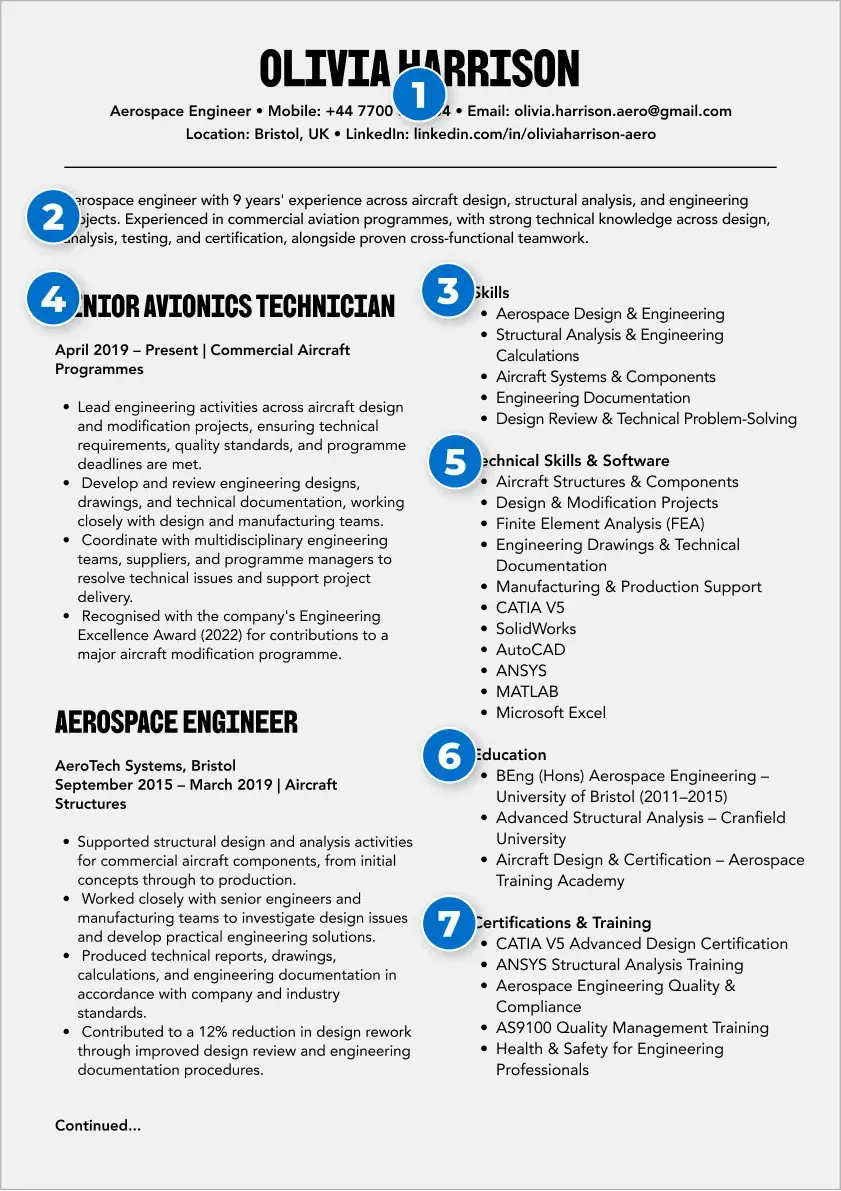
Most aerospace engineer resume examples will show you how the resume changes based on the level of experience of a job applicant. A well-written resume must also align with the career stage of the professional.
An entry-level sample resume for aerospace engineer will showcase limited professional experience. In this case, the resume should highlight education, internships, academic projects, technical skills, and relevant software proficiency. For the professional summary section, the resume can highlight the applicant’s knowledge of aircraft design, aerodynamics, structural analysis, and CAD modelling. Along with this, it is crucial to highlight hands-on experience gained through academic projects and an engineering internship.
Most aerospace engineer resume examples for experienced professionals should focus on professional accomplishments, technical expertise, projects, and measurable results. This type of resume must focus on the use of action verbs. Some examples include designed, analysed, developed, evaluated, tested, optimised, implemented, and collaborated.
Any sample resume for aerospace engineer for senior roles must demonstrate leadership, project management, decision-making, and the ability to manage complex engineering projects. It is important to focus on less routine tasks. The focus should be on leadership, project outcomes, technical decision-making, and cost or efficiency improvements.
Common Mistakes to Avoid
Even candidates with strong technical qualifications can weaken their applications by making avoidable resume mistakes. It is important to be thorough in your research and look at a sample resume for aerospace engineer to check for mistakes that can be avoided.
- One resume for everything: A generic resume will not be effective in demonstrating how you are suitable for the job. This role covers multiple areas such as aircraft design, aerodynamics, propulsion, structures, manufacturing, and systems engineering. It is important to carefully read the job description to know which one to apply for.
- Missing out on achievements: Recruiters want to see how your work led to tangible results for the organization. Simply describing what you were responsible for does not show the impact of your work. Where possible, use measurable results to demonstrate your contribution.
- Irrelevant skills: While the skills section is important, it is important not to make the list too long. This makes your resume difficult to read and may distract recruiters from your strongest qualifications. Keep changing the skills to match the job you are applying for. This way, you can confidently demonstrate your qualifications through your education or professional experience.
- Not listing software: Software proficiency is a big part of aerospace engineering. If you have experience with such tools, it is crucial to include that. However, avoid listing software simply because it is commonly used in the industry if you do not have practical experience with it.
- Jargon usage: Technical know-how is a big part of this role, but excessive jargon can make your resume difficult to understand. Use industry-specific terminology only when necessary. The focus must be on demonstrating technical expertise without becoming unnecessarily complicated.
- Ignoring ATS keywords: Many employers use Applicant Tracking Systems (ATS) to screen resumes before they reach a recruiter. Failing to include relevant terms from the job description can reduce the chances of your resume being shortlisted.
- Longer resume: Any sample resume for aerospace engineer will show you a concise resume. More information does not necessarily make a resume stronger. Focus on your most relevant qualifications and recent experience.
- Poor formatting: Formatting can strip your resume of the work you have done. It is crucial to avoid excessive graphics, complicated layouts, or decorative elements that can make the document difficult for recruiters or ATS software to read.
Aerospace Engineer Resume Keywords
Most aerospace engineer resume examples will help you understand the importance of using the right keywords. The right keywords can help recruiters quickly identify your relevant qualifications and improve the chances of your resume being noticed. The keywords you use should always reflect your actual skills and experience. Explore our blog to learn more about the aerospace engineer job description.
1. Technical and Engineering Keywords
Technical keywords are a good way to highlight your technical expertise. Depending on your specialization, you can make use of a number of such keywords. Some examples include Aerospace Engineering, Aircraft Design, Propulsion Systems, Aircraft Structures, Systems Engineering, Computational Fluid Dynamics (CFD), Materials Engineering, and Stress Analysis, among others.
2. Software and Tools Keywords
If you have practical experience in nursing industry-specific software or tools, it would be beneficial to include them. But including everything will make the list too long. It is important to prioritise software that you have used and that is relevant to the position.
For reference, one can use CATIA, SolidWorks, AutoCAD, Abaqus, LabVIEW, Python, CAD, FEA, and CFD, among others.
3. Industry and Compliance Keywords
Most aerospace engineer resume examples include keywords that help highlight one’s knowledge of quality, safety, manufacturing, and regulatory requirements. While such keywords are important, it is crucial to only include specific standards or certifications.
Some examples of such keywords include Aerospace Quality, Aviation Safety, Quality Assurance, Risk Management, Regulatory Compliance, Engineering Change Management, and AS9100, among others.
How to use keywords effectively: Any sample resume for aerospace engineer will not have a dedicated section of such keywords. Such keywords are used throughout the resume. While creating your resume, remember to incorporate these keywords naturally. This approach demonstrates that you have actually applied the skills rather than simply naming them.
Enjoying the article?
Follow us and never miss an update on the aviation industry.
Conclusion
The demand for aerospace engineers is expected to grow in the coming years. Several factors are influencing this growth. This includes the rise in commercial aviation, increasing government investment in military operations, and expansion of private and public space agencies. It is an exciting time to pursue this career path, with aspiring professionals having numerous opportunities to grow and advance in the field. Explore our blog to learn more about the most asked aerospace engineer interview questions.
With aerospace engineer jobs on the rise, a strong aerospace engineer resume is what aspiring professionals require to make it into the industry. Any sample resume for an aerospace engineer will tell you that it should do more than list your qualifications. Such a resume should clearly demonstrate your technical knowledge, engineering skills, professional experience, and achievements.
Whether you are a recent graduate or an experienced aerospace professional, a concise, well-structured, and job-specific resume can help you make a stronger impression.