
If you are aspiring to become an aeronautical engineer, then an aeronautical engineer resume sample is the most crucial thing you require to showcase your expertise. A well-structured resume can help demonstrate your suitability for a role and make a positive first impression. This is true for both recent graduates and experienced professionals.
Employers typically look for candidates with strong analytical skills, knowledge of aerodynamics, and proficiency in relevant engineering tools and software. An aeronautical engineer resume sample helps you highlight these qualifications. A well-written resume can help organise your qualifications, present relevant projects, and highlight measurable achievements.
In this guide, you will learn about the essential resume sections, discover practical examples, and explore tips for creating a professional resume tailored to your career goals.
Essential Sections
An effective aeronautical engineer resume sample should present the following in a clear, organized format. This includes your qualifications, technical expertise, and professional accomplishments. Each section has a purpose and should help recruiters know your capabilities.
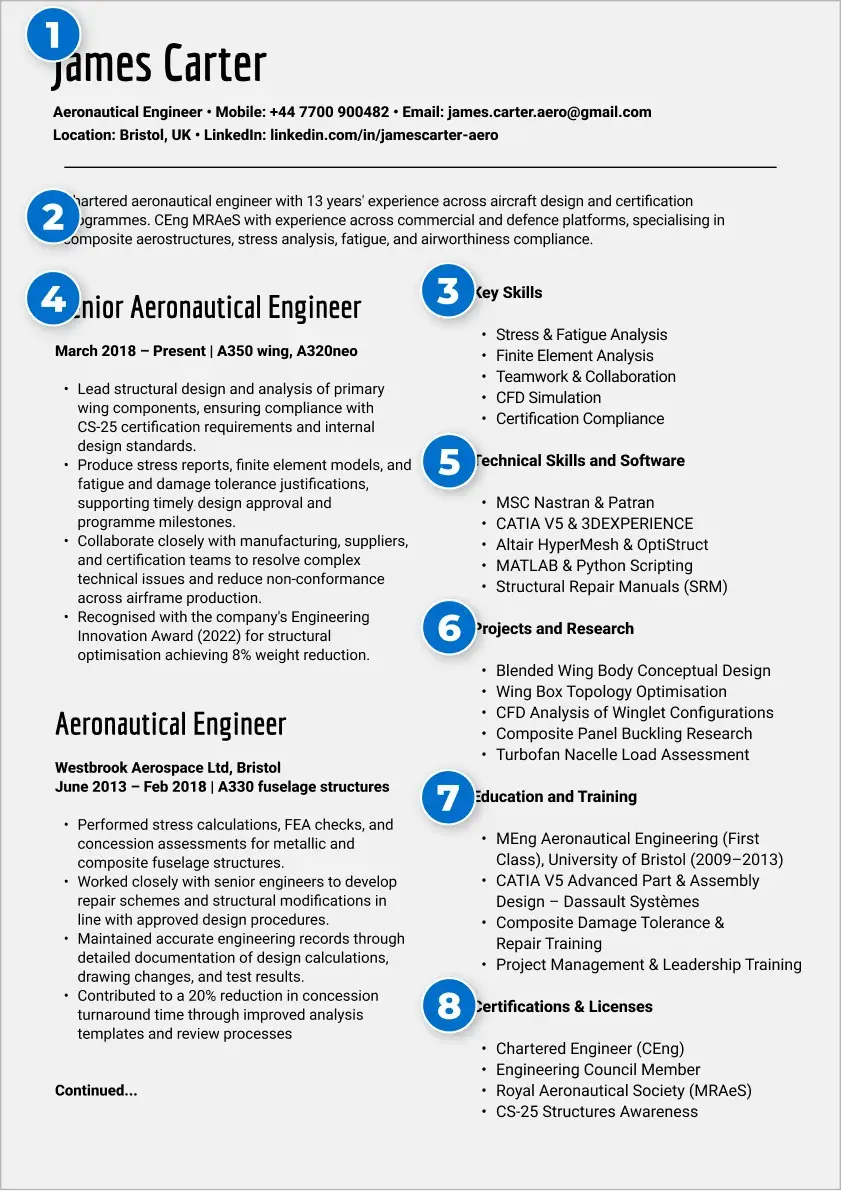
Here are the essential sections to include in your resume.
1. Contact Information
Any aeronautical engineer resume sample starts with contact information. This portion includes your full name and contact details so recruiters can reach you easily. Additionally, you can also include your phone number, professional email address, current city or location, and LinkedIn profile or portfolio link.
It is important to ensure that the contact information is accurate and up to date. If you add your portfolio, it must feature aircraft design projects, engineering simulations, or research work. These help demonstrate your practical abilities.
2. Professional Summary
Any aeronautical engineer resume sample will have a professional summary. This section contains a three- to four-line summary highlighting your experience, aeronautical engineering expertise, technical strengths, and career achievements. A summary helps recruiters have a quick understanding of your professional background and specialisation.
For example, you could highlight your experience in aircraft structural analysis, aerodynamic design, or flight testing. Recent graduates can focus on their academic qualifications, relevant projects, internships, and technical skills instead of professional experience.
3. Key Skills
An aeronautical engineer resume sample will have a section dedicated to key skills. It is important to include technical and professional skills relevant to the position you are applying for.
For technical skills, one can include aerodynamic analysis, aircraft design, structural analysis, computational fluid dynamics (CFD), CAD modelling, and problem-solving. Similarly, one must write about soft skills as well. This includes analytical thinking, teamwork, communication, and project management where relevant.
It is crucial to stay away from generic skills and focus on the relevant ones that match the job description.

Posted 2 days ago

 Verified

Posted 8 days ago
Verified

Posted 14 days ago
Verified
Posted 16 days ago
Verified

Posted 20 days ago
Verified

4. Professional Experience
The most important section of an aeronautical engineer resume sample is the professional experience section. This includes your current and previous roles, listed in reverse chronological order. Include the employer's name, job title, employment dates, and a few bullet points describing your responsibilities and achievements.
You can highlight your most relevant work pertaining to aircraft design, development, testing, manufacturing, or maintenance. Rather than listing responsibilities, highlight the impact of your work using measurable results. For instance, you can talk about reduced design time, improved component performance, or increased testing efficiency. Avoid simply listing routine duties.
5. Technical Skills and Software
An aeronautical engineer resume sample requires a section where you can highlight your expertise in software. You can mention software you have actually used, such as CATIA, AutoCAD, SolidWorks, ANSYS, or MATLAB.
Since aerospace engineering roles often require familiarity with specialised design, modelling, and simulation tools, this is a good place to focus on your skills. Where appropriate, specify how you used these tools, such as developing 3D aircraft component models, conducting stress analysis, or simulating aerodynamic performance.
6. Project and Research
This section of an aeronautical engineer resume sample is of particular value for fresh graduates and candidates with more experience in research-based projects. You can include academic or professional projects related to aircraft design, propulsion systems, aerodynamics, CFD, or structural optimisation.
You can also describe the project’s objective and your contribution. One can make this section more interesting by highlighting the practical applications of engineering concepts.
7. Education
The next part of an aeronautical engineer resume sample is education. Your resume should include your degree in aeronautical engineering, aerospace engineering, or a related discipline. You must also mention the institution's name, qualification, and graduation year.
Recent graduates can also highlight any academic achievements and research projects. This can help demonstrate their understanding of various engineering areas. This includes aircraft systems, aerodynamics, propulsion, and structural mechanics.
8. Certifications and Licenses
An aeronautical engineer resume sample also has a section where you can list your licenses and certifications. This may relate to CAD software, structural analysis, CFD, quality assurance, or aircraft maintenance.
While you list your licenses, you must also mention the issuing organisation and completion date where appropriate. Make sure any license or registration you mention is relevant to the role and issued by the appropriate authority.
Different Levels, Different Resumes
While an aeronautical engineer resume sample will tell you what a well-structured resume should have, it is important to align it to your seniority level. For instance, experienced professionals should emphasize industry contributions and project achievements. Similarly, fresh graduates can highlight their academic background, internships, and practical engineering skills.
1. Entry-Level Resume
If you are a recent graduate, you should focus on your academic qualifications, coursework, technical skills, and projects. You can highlight your familiarity with software such as CATIA, AutoCAD, ANSYS, or MATLAB. The professional experience section can focus on internships, research assignments, and participation in aircraft design projects.
Ultimately, the resume must demonstrate your eagerness to apply your engineering knowledge to aircraft development and performance optimisation.
2. Senior-Level Resume
With experience, there will be more areas one can focus on. You can prioritize professional experience, technical specialisation, and measurable achievements. One can also highlight responsibilities around aircraft design, testing, component development, or structural analysis. Whenever possible, demonstrate how your work improved efficiency, performance, safety, or design processes.
As someone with more years of experience, a well-structured resume should highlight the candidate’s adaptability, collaborative work style, and expertise in delivering projects with multidisciplinary teams.
3. Specialized Resume
For a specialized role, the focus changes a bit, depending on the role. For instance, if you apply for an aerodynamicist or structural design engineer role, your resume must include technical tools, research, certifications, and projects that are relevant to the job description.
For every experience level, customise your resume to the job description, use relevant keywords naturally, and provide accurate examples of your skills and accomplishments.
Common Mistakes to Avoid in Your Resume
Any aeronautical engineer resume sample should be reviewed to understand which mistakes to avoid. Certain mistakes can make it difficult for recruiters to identify your strengths and assess your suitability for a role. Here are some common errors to avoid.
- Using a generic resume: It is important not to submit the same resume for every application. For each job description, tailor your professional summary, skills, and experience to match the specific requirements.
- Listing skills without evidence: Your resume must mention software expertise. But only highlighting software such as CATIA, ANSYS, or MATLAB is not enough. Where possible, demonstrate how you have used these tools in professional assignments, internships, or academic projects.
- Overlooking achievements: Instead of describing responsibilities alone, highlight measurable outcomes. You can focus on improving design, reducing analysis time, or contributing to successful testing activities.
- Including irrelevant information: Prioritise qualifications, projects, and experience related to aeronautical engineering. Keep unrelated details brief unless they demonstrate transferable skills.
- Ignoring formatting and proofreading: Use clear headings, concise bullet points, consistent formatting, and professional language. Check for spelling and grammatical errors before submitting your resume.
- Exaggerating technical expertise: An aeronautical engineer resume sample will show you to include only the skills and experience you can confidently discuss during an interview.
Tailoring Your Resume to a Job Description
An aeronautical engineer resume sample must also show you how the resume must be tailored for each role. A generic resume will fail to impress recruiters. A resume that aligns with the role requirements will help recruiters shortlist your resume. Here’s what you can do.
To start with, identify the required skills in the job description. Look for technical competencies mentioned in the job posting. This includes aircraft design, aerodynamic analysis, structural testing, computational fluid dynamics (CFD), or finite element analysis (FEA). If you find any that you also have expertise in, include that in the resume.
Experience comes next in any aeronautical engineer resume sample. You just prioritize projects and responsibilities that match the role. For instance, a role involving aircraft design should focus on design modelling and simulation experience. Similarly, a testing role must highlight your involvement in performance evaluation, validation, and test procedures.
Keywords are of utmost importance. One must incorporate appropriate keywords throughout the resume. These keywords should be terms from the job description. This can improve the resume's relevance to applicant tracking systems (ATS) and help recruiters identify your suitability.
The section on professional experience must not be a sole account of responsibilities alone. Recruiters want to see the impact you have made in your current and previous organizations. Whenever possible, demonstrate the impact of your work using specific outcomes.
Any aeronautical engineer resume sample will show you only the relevant certifications, software expertise, and professional experience you can substantiate. Ultimately, a targeted resume presents your strengths clearly and helps recruiters understand how your background aligns with the aeronautical engineering role.
Future Prospects of Aeronautical Engineering
What does the future look like for those in aeronautical engineering? As we move ahead, several factors will play a key role in augmenting the scope of this role. This includes technological advancements, sustainability initiatives, and growing demand for more efficient aircraft. If you want to explore more about the role, explore our blog for the job description of an aeronautical engineer.
Amid these developments, aeronautical engineers will play an important role in developing next-generation aircraft. Globally, the demand for aeronautical engineers is expected to increase. According to one study, global demand for aeronautical and aerospace engineering is growing strongly, projected to expand by 8% from 2025 to 2035.
Manufacturers are looking at electric and hybrid-electric propulsion, sustainable aviation fuels (SAF), and hydrogen-powered aircraft. As a specialized sub-branch of the broader aerospace engineering discipline, people often get confused between the two. Explore our blog to learn more about the differences between aerospace and aeronautical engineering.
Enjoying the article?
Follow us and never miss an update on the aviation industry.
Wrapping Up
The future of aeronautical engineering looks bright, driven by advancements in aircraft design, sustainable aviation, automation, and aerospace technologies. As we move ahead, we will see more and more exciting opportunities opening up for both fresh graduates and experienced professionals.
As the aviation industry continues to evolve, skilled engineers will be essential to developing safer, more efficient, and environmentally sustainable aircraft. This means more aeronautical engineer jobs will be available for those interested in the field. Now is the time to prepare for the opportunities ahead.
This starts with assessing your qualifications, strengthening your technical skills, and creating a well-structured resume. An aeronautical engineer resume sample is often the first step towards getting noticed by potential employers. With the right preparation, you can position yourself on the path of growth. To help you in this direction, here’s a resource on the common questions asked during an engineering interview.