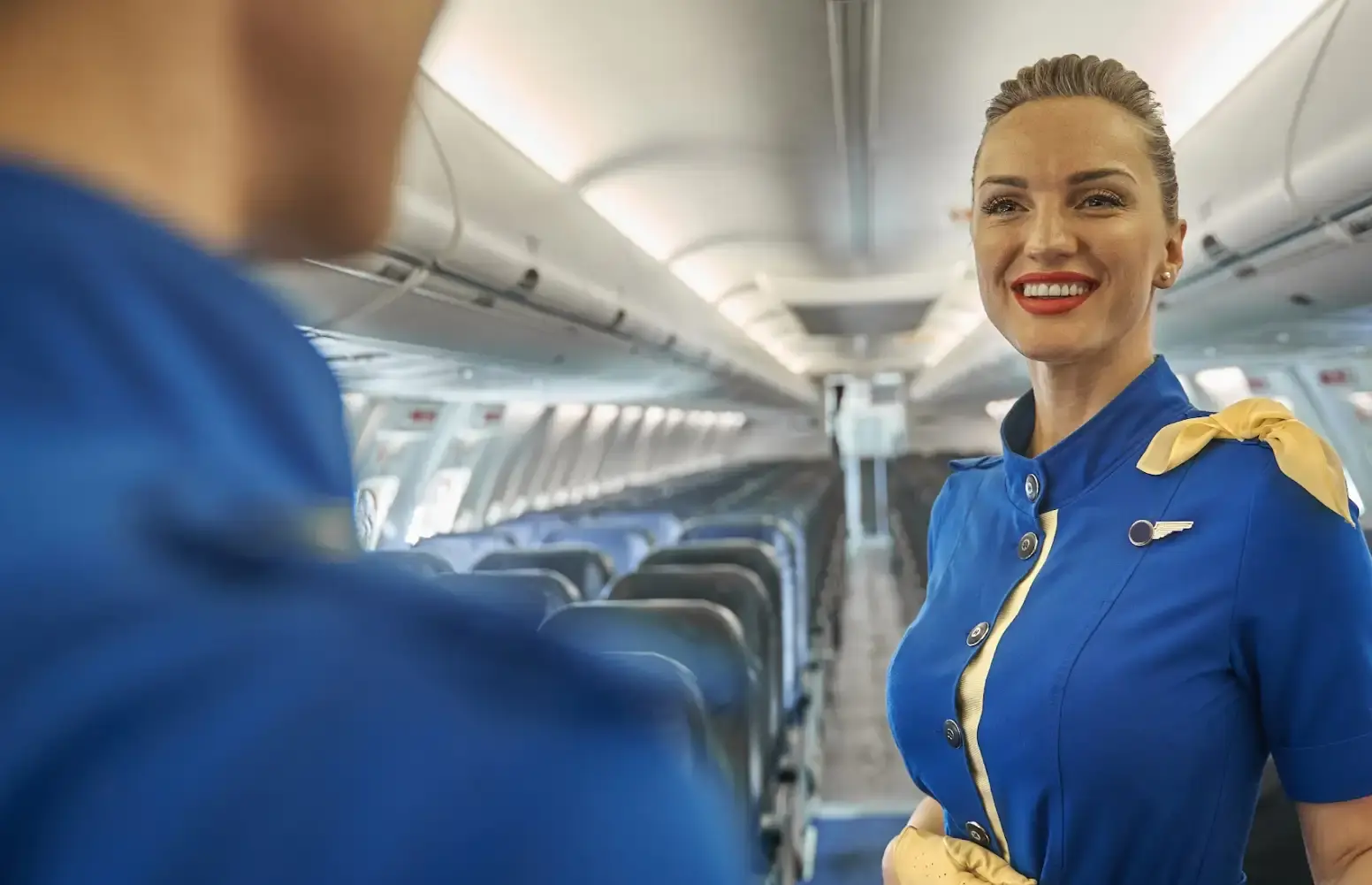
In any flight operating in any location, the role of the cabin crew is quite important. They are the first ones who meet the passenger and are paramount to the flying experience. The objective of the cabin crew is to ensure that the flying experience is pleasant and safe for the passengers. This is why aspiring individuals looking to make a career in this domain are first inclined to know about the cabin crew salary.
1. United Kingdom
Salary: The cabin crew salary in the United Kingdom is dependent on various factors, such as the airline, route network, and level of experience. The average cabin crew salary ranges between £18,000 and £25,000 ($24,191.55 and $33,599.38) annually. As one progresses in their career, one can earn anywhere between £30,000 and £45,000 ($40,319.25 and $60,478.88) per year. Additional benefits include flight rate per hour on duty, performance bonuses, commission for in-flight retail, and a monthly allowance for speaking several languages.
Qualification: The minimum qualification for cabin crew in the UK is a GCSE-level qualification, and applicants must be at least 18 years of age. English language proficiency is mandatory, and additional language skills are often beneficial for international routes and have a huge impact on the cabin crew salary. Candidates also need to pass a medical assessment, along with a background check and security clearances. Most airlines provide cabin crew training, including first aid, safety knowledge, and customer service skills.
2. India
Salary: The cabin crew salary in India varies, depending on the airline, experience level, and whether the carrier operates domestic or international routes. The average salary of a cabin crew member ranges between ₹25,000 and ₹60,000 ($260.91 and $626.18) per month. With more experience and higher designations, the cabin crew pay rises to ₹80,000 to ₹1.5 lakh ($834.90 to $1,565.44) per month. Cabin crew also receive additional compensation like bonuses, profit sharing, tips, commissions, and overtime pay. International airlines also provide perks like accommodation, bonuses, and flight allowances.
Qualification: To become a cabin crew member in India, you will require a high school diploma from a recognized board, besides being 18 years of age. Some airlines have more specific qualification criteria. In addition to these, you must complete a certified air hostess course or specialized cabin crew training program. Besides all this, fluency in English is essential, and knowledge of additional languages can be advantageous.

Posted 11 days ago

 Verified

Posted 13 days ago
Verified
Posted 13 days ago
Verified
Posted 13 days ago
Verified
Posted 13 days ago
Verified
Posted 13 days ago
Verified
Posted 13 days ago
Verified
Posted 13 days ago
Verified


Posted 3 days ago
3. United States
Salary: The cabin crew salary in the United States is one of the highest in the world. The salary of a cabin crew member is dependent on the airline's size, union agreements, and years of service. The airline cabin crew salary for entry-level flight attendants is between $35,000 and $50,000 annually. As one progresses through their career, the compensation increases and ranges between $70,000 to over $100,000 per year. Other benefits include per diem payments, profit-sharing programs, bonuses, and international layover allowances.
Qualification: To become a cabin crew member in the United States, you will require a high school diploma or equivalent. Many airlines prefer candidates who have college education or prior experience in related fields, such as hospitality, customer service, healthcare, or tourism. You must also be 21 years of age, pass a medical exam that includes vision and hearing tests, be able to swim 50 meters, and be able to travel abroad. Additionally, strong communication skills, professional appearance, and the ability to work flexible schedules are essential and impacts the cabin crew salary.
4. Canada
Salary: The cabin crew salary in Canada is dependent on various factors, including airline size, route structure, and employee experience. The average cabin crew salary typically falls in the range of CAD 35,000 and CAD 50,000 ($25,214.17 and $36,020.25). As one progresses in their role, the salary of a cabin crew member increases to CAD 60,000 to CAD 90,000 ($43,224.30 to $64,836.45) or more. The cabin crew pay increases when one with international carriers and long-haul operations. Additional benefits often include travel allowances, health insurance, retirement plans, and discounted flight privileges.
Qualification: To become a cabin crew member in Canada, you will require a high school diploma, which is the minimum educational qualification. Many employers prefer post-secondary education in hospitality, tourism, or aviation. Other than proficiency in English language, proficiency in French is highly desirable, particularly for routes serving bilingual regions. One must also pass the background check and complete a training program.
5. Australia
Salary: The cabin crew salary in Australia varies, depending on airline reputation, route network, and seniority. The average cabin crew salary for an entry-level position is generally between AUD 50,000 and AUD 65,000 ($35,680.00 and $46,384.00) annually. The salary of a cabin crew member for experienced roles ranges between AUD 80,000 to AUD 100,000 ($57,088.00 to $71,360.00) or more. The airline cabin crew salary also includes additional benefits in the form of overnight allowances, international travel benefits, and other flight-related incentives.
Qualification: To become a cabin crew member in Australia, a high school diploma is the minimum qualification. Candidates must also be at least 18 years of age and possess unrestricted working rights in Australia. Aspiring candidates will benefit from undergoing a cabin crew training program from a reputed school since any airline values this qualification. Passing medical assessments is also mandatory, which includes physical capability to perform safety-related duties.
6. Germany
Salary: The cabin crew salary in Germany is quite competitive. The average cabin crew salary for entry-level positions ranges between €25,000 and €35,000 ($29,098.50 and $40,737.90) annually. For experienced cabin crew in senior roles, the cabin crew pay is generally between €40,000 and €60,000 ($46,557.60 and $69,836.40) or more a year. Additional benefits of the salary of a cabin crew includes flight allowances, meal allowances, travel discounts, and comprehensive employee benefit packages.
Qualification: Aspiring cabin crew must have a high school diploma or equivalent. Many employers value candidates who either have university education or prior experience in customer service, hospitality, tourism, and related fields. All of this has an impact on the cabin crew salary. One must also be fluent in German and English language, which is often required for international operations. Additional language skills can significantly enhance employability. Candidates must also meet certain physical and medical requirements as well as pass security clearances.
7. United Arab Emirates
Salary: The cabin crew salary in the United Arab Emirates is one of the highest in the world, since the country offers almost tax-free income. Apart from a competitive air cabin crew salary, UAE is a popular hub for many other aviation roles. The salary of a cabin crew for entry-level cabin members is between between AED 8,000 and AED 12,000 ($2,178.35 and $3,267.53) per month. The airline cabin crew salary for senior roles tends to go higher than this. The cabin crew pay also includes other benefits, such as furnished accommodation, transportation, medical insurance, annual leave tickets, and travel privileges.
Qualification: To become a cabin crew member in the UAE, you will need a high school diploma. It is also mandatory to be at least 21 years old, besides having excellent English language and communication skills. It is also mandatory for candidates to pass the country’s strict height, grooming, and medical fitness requirements. Employers in the UAE also undertake background checks for successful candidates.
8. Japan
Salary: The cabin crew salary in Japan depends on various factors, such as airline, route network, and employee experience. The cabin crew pay for entry-level positions typically falls in the range of ¥3 million and ¥5 million ($18,758.68 and $31,262.80) annually. The air cabin crew salary for experienced cabin crew members is higher, hovering in the range of ¥6 million and ¥8 million ($37,515.36 and $50,022.98) or more. Cabin crew salaries also include flight allowances, accommodation support during layovers, bonuses, and employee travel benefits.
Qualification: To become a cabin crew member in Japan, you will require a high school diploma. A university degree can substantially enhance one’s employment prospects. One must also have strong communication skills and excellent customer service abilities. Proficiency in Japanese as well as English language is an absolute must as it directly impacts the cabin crew salary. Additionally, applicants must meet physical fitness and medical requirements and pass extensive screening processes, including interviews and background checks. Explore our blog to know more about cabin crew medical tests.
Additional Benefits
Besides the air cabin crew salary, successful candidates who join an airline are also provided with some attractive benefits. These benefits, coupled with cabin crew salaries, makes this role that much attractive for aspiring professionals.
- Allowance payments: When researching how much do cabin crew get paid it is important to not overlook allowance payments. This type of payment is provided by the airline for the nights spent away from base. However, not all airlines pay for allowances; some have a set figure.
- Language payments: Some airlines will include a small monthly allowance in their air cabin crew salary for language speakers. You may get paid a little extra if you speak a language fluently and can make public announcements onboard regular flights.
- Commission from duty-free sales onboard: Besides, the air cabin crew salary, this refers to the percentage of the revenue generated from selling duty-free items like perfumes, alcohol, or electronics on an airplane to passengers. This may be between 5-10% of total sales on board, shared by the whole crew.
- Pension schemes: Besides the cabin crew pay, you might also receive a pension scheme. Most scheduled airlines and some charters also offer reduced price tickets or staff travel on standby (if there is a seat available last minute!) which can be helpful if you wish to commute or travel during your annual leave.
- Discounts: The air cabin crew salary also includes discounts. This counts towards the salary of a cabin crew. As your uniform is important to the company image, the company will normally pay for you to have it dry cleaned and some have laundry facilities at base for you to drop off your uniform.
Professional Development
Before looking at how much do cabin crew get paid, it is also important to research on the various responsibilities of cabin crew. This will give you a clear idea of what an average day in the life of a cabin crew member looks like.
Training is a very big part of this role and has an impact on the airline cabin crew salary. Most airlines have a structured training programme for new entrants. Post-COVID, some of the training modules are also carried out virtually. Typically, the training program will last between four and eight weeks, though longer if you're in a specialist position such as First Class, which also impacts the air cabin crew salary.
Now, these training programs focus on teaching the candidates about passenger safety, including the aircraft's safety equipment and emergency procedures, security and first aid, and service and hospitality.
In addition, the training will include topics such as cultural awareness, currency exchange, customs and immigration rules, first aid and CPR, self-defense, fire fighting, food prep and service, gallery management, customer service, and product knowledge.
Enjoying the article?
Follow us and never miss an update on the aviation industry.
Conclusion
For many, flight attendants and cabin crew become interchangeable. But there is a slight difference.The cabin crew comprises everyone who works onboard the airplane. This includes the flight attendants, senior flight attendants, and even onboard chefs on more significant flights. In this lot, flight attendants instruct patients on emergency situations and take care of the passengers. If you're preparing for your upcoming flight attendant interview, explore our blog for a detailed guide to the most commonly asked flight attendant interview questions.
In the past few years, we have seen an exponential increase in cabin crew jobs primarily due to the rising demand for air travel, with more people flying globally, leading to airlines expanding their fleets and routes. With growing opportunities in the industry and substantial increase in the airline cabin crew salary, now is a great time to pursue this career and enjoy a rewarding professional experience.